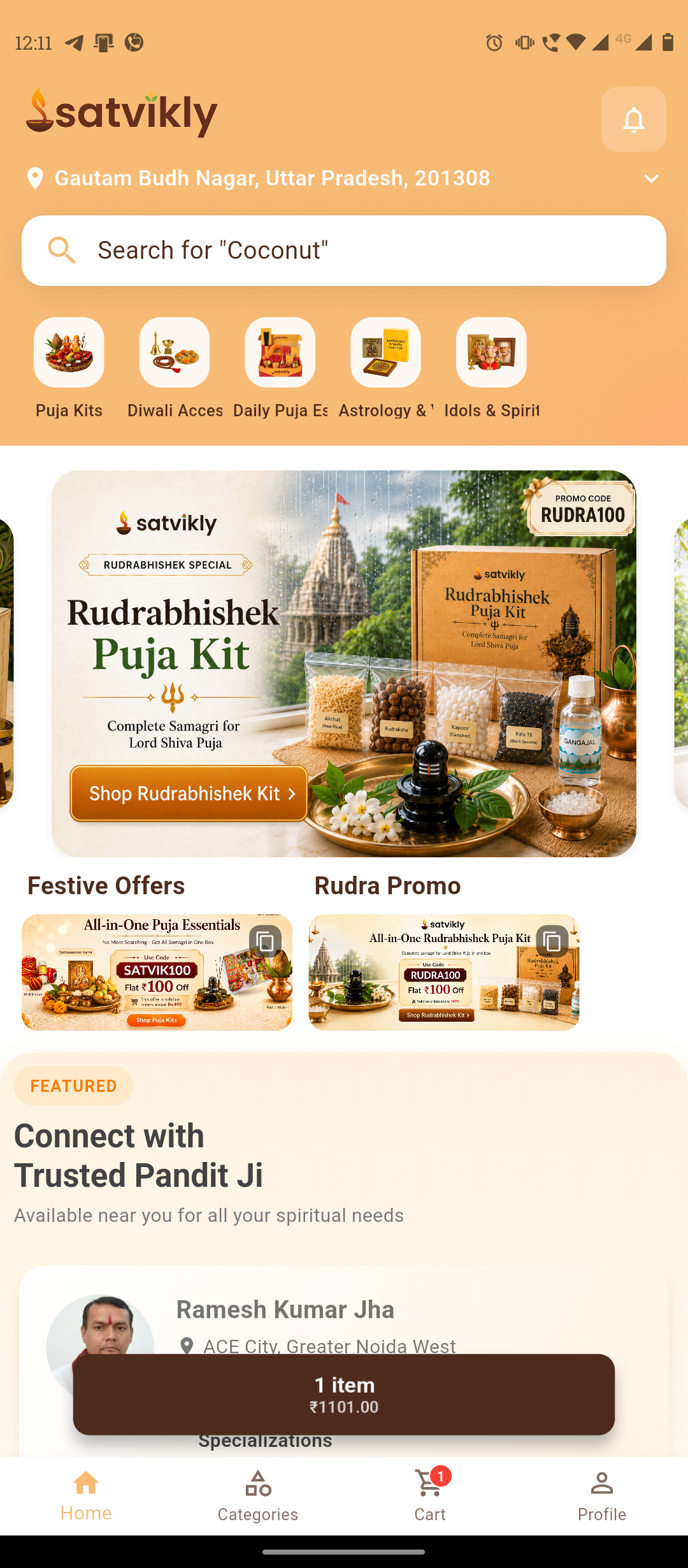
Satyanarayan Pooja: Vidhi, Samagri, Katha, Aarti & Prasad
Satyanarayan Pooja is worship of Lord Vishnu as Satyanarayan. First confirm Tithi (तिथि), Sankalp (संकल्प), and Samagri (सामग्री). Keep the Katha, Aarti, and Prasad ready. Follow one Vidhi from Ganesh Pooja through Aarti and Prasad.
Sampooran Satyanarayan Pooja Kit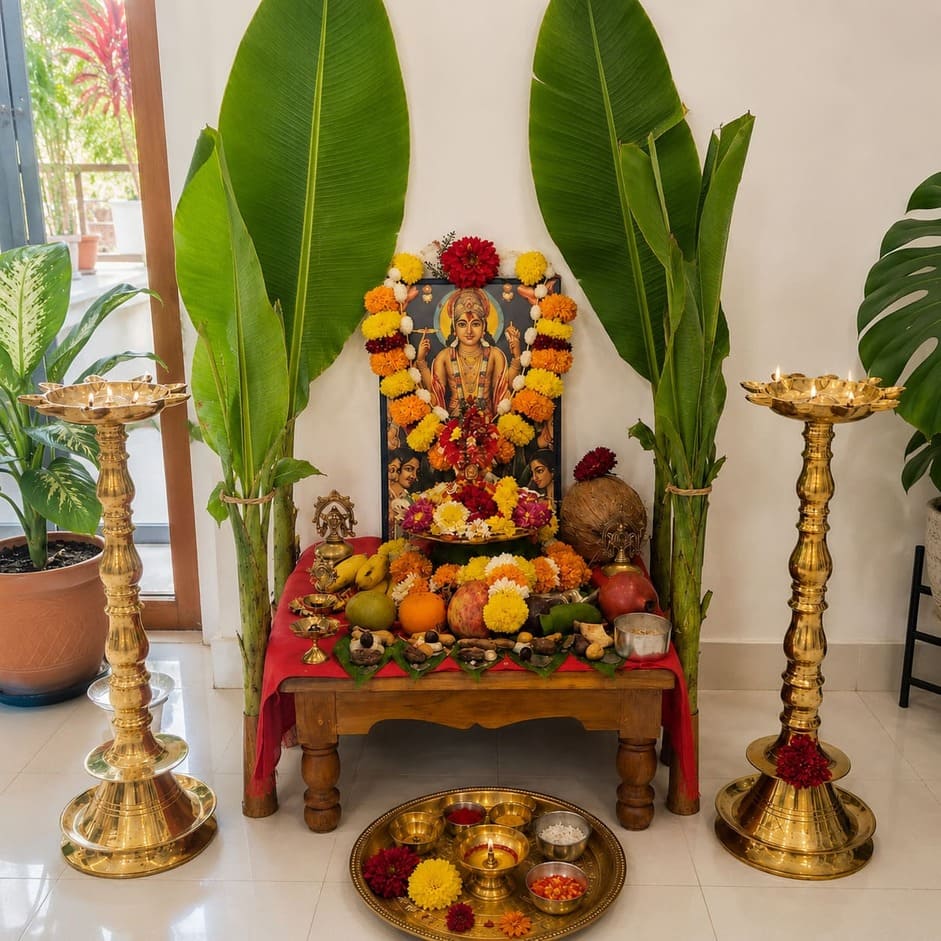
Satyanarayan Pooja Quick Facts
Every answer you need before fixing the date and buying Samagri.
What Is Satyanarayan Pooja?
Satyanarayan Pooja (सत्यनारायण पूजा) is worship of Lord Vishnu as Satyanarayan. Satya refers to truth, while Narayana is a name of Vishnu. Sankalp, Pooja, 5 Katha Adhyay, Aarti, and Prasad form its main parts.
The worship is also called Satyanarayan Vrat or Satyanarayan Katha Pooja. Each name covers one part of the worship. Pooja is worship, Vrat carries Sankalp, and Katha is the holy story.
Who Is Lord Satyanarayan?
Lord Satyanarayan is Lord Vishnu worshipped as the Lord of Truth. He is also called Shri Satyanarayan or Satya Narayan Bhagwan. Worship focuses on truth, Sankalp, Bhakti (भक्ति), and respect for Prasad.
Satyanarayan is Lord Vishnu, not a separate Bhagwan. Family books can use different names during prayer. Lord Vishnu remains the main Bhagwan worshipped during the pooja.

Pooja, Vrat and Katha: the Difference
Pooja is worship with flowers, Diya, food, and mantras. Vidhi (विधि) is the order followed; Samagri (सामग्री) covers every item used during each step.
Vrat is your Sankalp and its worship rules. Food fasting is one part in some homes. Vrat also includes Katha, prayer, good behaviour, and Prasad.
Katha is the sacred story read during the Vrat. Satyanarayan Katha has 5 Adhyay (अध्याय), or 5 chapters. Read all 5 chapters in the correct order.
Where Does Satyanarayan Katha Come From?
The Sanskrit Katha names Reva Khanda of Skanda Purana. Adhyay 1 starts with Suta Ji, Narad Ji, and Lord Vishnu. Later chapters cover a Brahmin, woodcutter, merchant, his family, and kings.
Ganesh Pooja, Kalash Sthapana, 16 Upachar, and Havan come from pooja practice. Their order changes across Paddhati (पद्धति) books. Choose one Paddhati and follow it through the closing prayer.
Satyanarayan Pooja Benefits and Purpose
Satyanarayan Pooja is done for Vishnu worship, truth, and Sankalp. Katha teaches you to remember Bhagwan after success. It also teaches honesty, less pride, and respect for Prasad.
Devotees pray for peace, health, family welfare, and prosperity (समृद्धि). Pooja is also done before a new beginning. Write the main purpose before taking Sankalp.
Decoration and extra Samagri do not replace the main worship. Complete Sankalp, hear all 5 Adhyay, and receive Prasad. All 3 parts are important in the Katha.
Where Can You Do Satyanarayan Pooja?
Perform Satyanarayan Pooja at home, office, shop, or new property. Use a hall when many guests attend. Choose a clean place with enough time for all 5 Adhyay.
For home pooja, use a stable Chowki (चौकी) and safe Diya area. Keep children away from Kapoor, matches, and hot vessels. Open windows when Dhoop or Havan smoke collects.
Ask the temple which vessels and Samagri are already available. Offices and shops may restrict fire, smoke, or guest entry. Keep Prasad away from footwear and packing waste, cover it until Naivedya, and arrange easy seating for older people.

Best Day, Time and Duration for Satyanarayan Pooja
Purnima is the main date for Satyanarayan Pooja. It is not the only date. Morning and evening worship are both followed during the chosen Tithi.
Is Purnima Compulsory?
No, Purnima is not compulsory for every Satyanarayan Pooja. Purnima (पूर्णिमा) is the full-moon Tithi. Many devotees select it for Satyanarayan Vrat and Katha.
You may select another date for Griha Pravesh or a Sanskar. Birthday, anniversary, new work, or completed Sankalp can decide the date. Follow the date chosen through your Panchang and Paddhati.
Tithi (तिथि) is the Hindu calendar date. It may begin after an English calendar day starts. It may also end before the next evening.
Morning or Evening?
Pooja can be done in the morning or evening. Many families choose evening and eat after Prasad. Morning Pooja works when the chosen Tithi continues.
Muhurat (मुहूर्त) is the chosen pooja time. It changes by date and city. Check Satyanarayan Puja dates for your location before calling guests.
Do not copy another city time from social media. Sunrise and Tithi timings can differ by location. Ask your Pandit Ji when Sankalp needs full Panchang details.
How Long Does Satyanarayan Pooja Take?
Satyanarayan Pooja takes about 90 minutes to 3 hours. Katha speed, mantra length, guest count, and Havan affect total time. Keep extra time for Aarti and Prasad.
| Pooja stage | Time needed |
|---|---|
| Chowki and Samagri setup | 20 to 40 minutes |
| Sankalp and opening Pooja | 20 to 35 minutes |
| Main Satyanarayan worship | 30 to 50 minutes |
| Reading all 5 Adhyay | 35 to 75 minutes |
| Aarti and Prasad | 15 to 25 minutes |
| Havan | 30 to 60 added minutes |
| Total | About 90 min – 3 hrs |
A short home Pooja may finish within 2 hours. Full Pooja with Havan may cross 3 hours. Confirm the expected order before inviting guests.
Who Can Perform Satyanarayan Pooja?
One person, a couple, or a family can perform Satyanarayan Pooja. Women and unmarried devotees also perform the worship. Family Parampara (परंपरा), or family method, decides the main Sankalp. Children can offer flowers under adult watch, and family members can share Katha reading — keep one book and read all 5 Adhyay in order.
Do you need a Pandit?
A Pandit Ji is helpful for Panchang, Sankalp, mantras, and pooja order. However, Satyanarayan Puja is also performed at home without a Pandit. Use one checked Paddhati and keep every item ready.
Do not mix steps from several books and videos. One source may place Navagraha Pooja before Kalash worship; another may leave that step out.
Fasting rules and who can join
Fasting rules differ by Parampara. Some devotees take water, fruit, or milk; some take one light meal before evening worship. Vrat covers more than food fasting — Sankalp, Katha, truth, worship, and Prasad remain part of Vrat. A person unable to follow food fasting can still perform Pooja.
Do not stop medicine, water, or required food. Children, pregnant people, older adults, and people with diabetes need medical advice — health comes before a strict food rule. Wear clean clothes suitable for floor seating; keep loose Dupatta, Saree Pallu, and sleeves away from flames.
Pandit Ji for Satyanarayan Pooja
Verified Acharyas who perform Satyanarayan Vrat, Katha and Havan. Each Pandit Ji reads the Panchang for your city, states the Sankalp, and follows one Paddhati from Ganesh Pooja through Prasad.

Mukesh Kumar Jha
 Greater Noida
 8 years exp.
Satyanarayan Pooja Laxmi Poojan Diwali Pooja
Starting from ₹1,300

Raghuraj Shastri
South Delhi
20 years exp.
All Types of Pooja Satyanarayan Pooja Diwali Pooja
Starting from ₹2,100
Home worship without a Pandit Ji is also followed — use one checked Paddhati and keep every item ready.
Satyanarayan Pooja Types: Katha, Full Pooja and Havan
Time, quantity, space, and Pandit work depend on this choice.
Satyanarayan Katha with Short Pooja
Includes Sankalp, Ganesh prayer, Satyanarayan worship, 5 Adhyay, Aarti, and Prasad.
Follow one checked home Vidhi.
Complete Satyanarayan Pooja
Includes Sankalp, Ganesh Pooja, Kalash Sthapana, 16 Upachar, Katha, Aarti, and Prasad.
Some Paddhati books add Navagraha worship and Pushpanjali.
Satyanarayan Pooja with Havan
Adds Havan (हवन), or fire worship, after the main Pooja.
Arrange Havan Kund, Samidha, Ghee, and Havan Samagri.
How to Prepare for Satyanarayan Pooja
First confirm Tithi, Pooja type, guest count, and Prasad amount. Then separate reusable items, packed Samagri, and fresh items. Open every packet before the pooja date.
Confirm before the pooja date
- Date, Tithi, and start time
- Pooja place
- Short Pooja, full Pooja, or Havan
- Pandit Ji or home Paddhati
- Number of people hearing Katha
- Number of Prasad portions
- Satyanarayan photo or Murti
- Katha book and Aarti book
- Packed Samagri
- Fresh flowers, Tulsi, fruit, milk, and curd
- Havan Kund and fire safety when needed
Order packed items before the pooja week. Open the box after delivery and match every packet with your Pandit list.
Pooja-day setup and Chowki
Clean the pooja room, Chowki, vessels, and food area. Bathe and wear clean clothes. Wash each bowl, spoon, Lota, Pooja thali, and Diya.
Cover a stable Chowki with clean cloth. Place Satyanarayan or Vishnu photo or Murti (मूर्ति) at the centre. Keep Ganesh Ji, Kalash, Diya, Katha book, and offering plates nearby.
Follow the direction used in your Paddhati. Keep liquid away from paper pictures and electric wires. Place matches and Kapoor outside the reach of children.
Keep Naivedya and Prasad covered nearby. Do not taste food before offering when Parampara follows that rule. Keep drinking water and required medicines nearby.
Satyanarayan Puja Samagri List
Samagri must match the chosen Vidhi. Separate Chowki items, daily Pooja items, Kalash items, Panchamrit, fresh offerings, and Prasad ingredients. Add Havan items only when Havan is included.
Open each group to see every item with its quantity. Havan and Navagraha items apply only when those steps are part of your Paddhati.
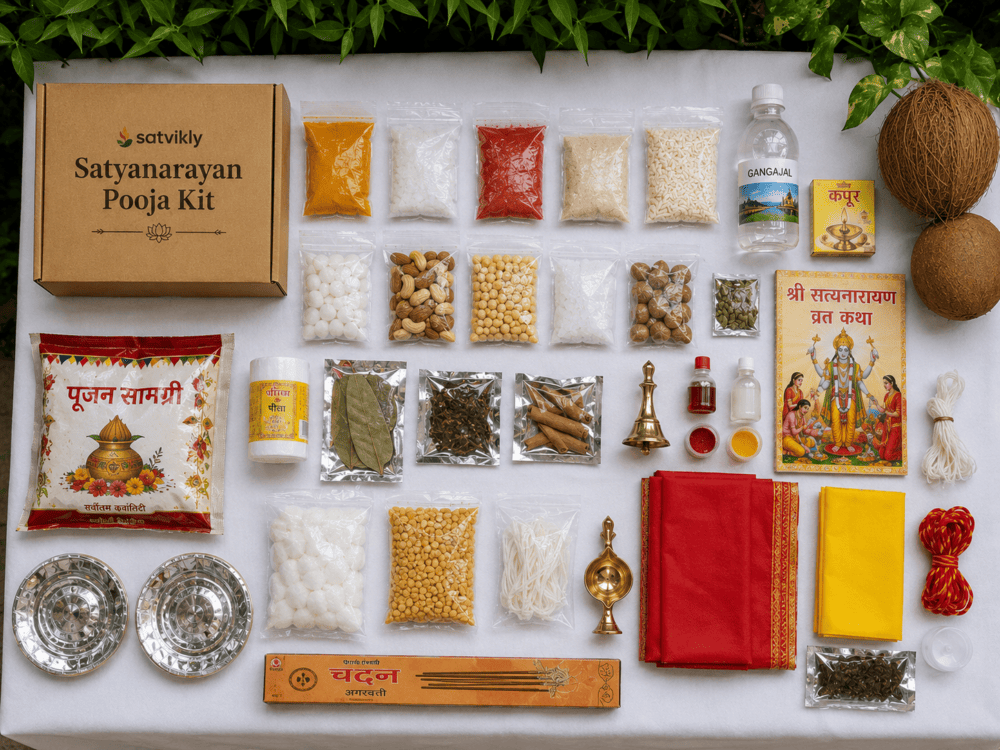 PACKED SAMAGRI KIT
Satvikly Satyanarayan Pooja Kit
View kit contents
PACKED SAMAGRI KIT
Satvikly Satyanarayan Pooja Kit
View kit contents
Chowki & items used again
13 items
Use a Murti suitable for Panchamrit Snan. Do not pour liquid over paper, paint, wood, or electric frames. Use a separate bowl for small water offerings.
Daily Pooja items
17 items
Kalash items
6 items
Panchamrit items
5 items
Panchamrit (पंचामृत) is made with these 5 ingredients. Prepare more when the Murti needs full Snan.
Fresh offerings
9 items
Buy fresh items near the pooja date. Wash fruit and leaves with clean water; dry them before placing near the Chowki.
Prasad ingredients
7 items
Havan items (when included)
7 items
Navagraha items (when included)
5 items
Navagraha (नवग्रह) Pooja is worship of 9 Graha. Leave out these items when Navagraha Pooja is not included — confirm before buying the kit.
Check packed and fresh Samagri: Satvikly packs listed non-fresh Pooja items. Arrange flowers, Tulsi, fruit, milk, curd, leaves, and prepared Prasad near the Pooja date.
Check Satyanarayan Puja Kit contents →Satyanarayan Pooja Sankalp
Sankalp (संकल्प) records who is performing Pooja, where, when, and for what purpose. Take Sankalp before the main worship begins. Keep ready: full name, Gotra (गोत्र) when known, city and Pooja place, date and Tithi, Pooja purpose, main wish, and the Katha and Havan choice.
Full Sanskrit Sankalp may include month, Paksha (पक्ष — one lunar half-month), Tithi, weekday, and Nakshatra (नक्षत्र). A Pandit Ji reads these details from the local Panchang.
SHORT HINDI SANKALP · HOME WORSHIP
मैं [नाम], [स्थान] में, [तिथि] को, [उद्देश्य] के लिए श्रद्धा से श्री सत्यनारायण व्रत, पूजा और कथा का संकल्प करता या करती हूँ।
I, [name], at [place], on [date], take Sankalp for Satyanarayan Vrat, Pooja, and Katha for [purpose].
SHORT SANSKRIT LINE · WORSHIP PROMISE
ॐ श्रीसत्यनारायणप्रीत्यर्थं श्रीसत्यनारायणव्रतपूजनं करिष्ये।
Replace every bracketed field before starting Pooja. Do not invent a Gotra — tell your Pandit Ji when it is unknown.
Satyanarayan Puja Vidhi in Order
Start with cleaning and Sankalp. Continue through opening Pooja, Satyanarayan worship, Katha, Aarti, and Prasad. Keep all Samagri within reach before Sankalp — one person should manage water, flowers, Diya, and Prasad; another can manage the Katha book.
PHASE 1
Clean the Place and Set the Pooja Chowki
Light the Diya after moving cloth and wires away. Place Kapoor on a heat-safe plate. Open windows when Dhoop smoke becomes heavy.
PHASE 2
Take Sankalp and Perform Opening Pooja
Fill the Kalash with clean water and Gangajal. Add coin and Akshat where used. Tie Mauli around the vessel, then place leaves and coconut.
PHASE 3
Worship Lord Satyanarayan
For a photo, place water offerings in a separate bowl and touch a flower to the bowl during each step. Never pour Panchamrit over paper or painted frames. Tulsi is used during Vishnu worship — if not available, ask Pandit Ji before using another leaf.
PHASE 4
Read 5 Katha Adhyay and Perform Aarti
More than one person can read the Katha. Use one checked text from start to end. Do not skip any Adhyay because a guest arrived late.
PHASE 5
Close the Pooja and Share Prasad
Katha has 5 Adhyay. Shodashopachara has 16 Upachar. Full Pooja includes many steps outside these 16 offerings.
16 Upachar in Satyanarayan Pooja
Upachar (उपचार) is an offering made during worship. The order below follows a widely used Satyanarayan Pooja Vidhi.
Dhyana (ध्यान)
Remember Lord Satyanarayan.
Avahan (आवाहन)
Invite Bhagwan for worship.
Asana (आसन)
Offer a seat.
Padya (पाद्य)
Offer water for the feet.
Arghya (अर्घ्य)
Offer welcome water.
Achamaniya (आचमनीय)
Offer water for sipping.
Panchamrit Snan (पञ्चामृत स्नान)
Bathe a suitable Murti.
Shuddhodaka Snan (शुद्धोदक स्नान)
Bathe with clean water.
Vastra (वस्त्र)
Offer cloth.
Yajnopavita (यज्ञोपवीत)
Offer Janeu.
Chandan (चन्दन)
Apply sandal paste.
Pushpa (पुष्प)
Offer flowers and Tulsi.
Dhoop (धूप)
Offer incense.
Deep (दीप)
Offer light.
Naivedya (नैवेद्य)
Offer food.
Tambula (ताम्बूल)
Offer Paan and Supari.
Drik Panchang lists the 16-step worship order. Ganesh Pooja, Sankalp, Katha, Aarti, Pushpanjali, Pradakshina, and Prasad are outside the count — full Pooja has more than 16 steps.
5 Adhyay in Satyanarayan Katha
Read all 5 as one connected Katha. Each chapter covers Sankalp, truth, pride, or respect for Prasad. The Sanskrit Satyanarayan Vrat Katha contains all 5 Adhyay.
It starts with Narad Ji and Lord Vishnu. Later chapters cover the Brahmin, woodcutter, merchant, Kalavati, and 2 kings — every chapter closes with one teaching.
1
ADHYAY
Narad Ji Asks Lord Vishnu
Sages at Naimisharanya ask Suta Ji about worship during human trouble. Suta Ji repeats a question asked by Narad Ji, who had seen pain in the human world. Narad Ji asks Lord Vishnu for a worship people can perform. Lord Vishnu describes Vrat, Naivedya, Katha, Dakshina, and Prasad. The chapter also names evening as a pooja time.
TEACHINGBegin with Bhakti, truth, and sincere Sankalp.
2
ADHYAY
Poor Brahmin and Woodcutter
A poor Brahmin in Kashi receives Satyanarayan Vrat teaching, takes Sankalp, performs the Pooja with relatives, then keeps the Vrat again. A woodcutter sees the Brahmin performing the Pooja, asks about it, receives Prasad, and takes Sankalp. After selling wood, he buys banana, Ghee, milk, flour, and sweetener and performs the Vrat with relatives. His story belongs in Adhyay 2, not Adhyay 3.
TEACHINGHear the Katha, take Sankalp, and complete it.
3
ADHYAY
King Ulkamukha and Merchant Pooja Promise
King Ulkamukha performs Satyanarayan Vrat near a river. Merchant Sadhu watches the worship and promises the Vrat after receiving a child. His wife Lilavati later has a daughter named Kalavati, but Sadhu delays the Vrat until her marriage and forgets again while travelling with his son-in-law. A theft in King Chandraketu’s city leads to their arrest; Lilavati and Kalavati face hardship at home. Kalavati hears Satyanarayan Katha in a Brahmin home, Lilavati performs the Vrat, and King Chandraketu receives a dream and releases the men.
TEACHINGComplete Sankalp after receiving the prayed-for result.
4
ADHYAY
Merchant Returns and Kalavati Forgets Prasad
Merchant Sadhu begins his return journey after release. Lord Satyanarayan appears in another form and asks about the boat goods; Sadhu answers falsely, and his goods appear changed. Sadhu accepts his mistake, asks forgiveness, and his goods return. Near home, Lilavati performs Satyanarayan Pooja before meeting him — but Kalavati leaves without taking Prasad, and the Katha links the mistake with another loss. She returns, receives Prasad, and goes back to her family.
TEACHINGSpeak truth and receive Prasad before leaving.
5
ADHYAY
King Tungadhwaja and Cowherds
King Tungadhwaja sees cowherds performing Satyanarayan Pooja but ignores the worship and does not receive Prasad. Later hardship reminds him about the mistake. The King returns, performs worship, and receives Prasad. His story closes the Katha with a lesson against pride — worship should continue during success and trouble.
TEACHINGLeave pride and respect Pooja, Katha, and Prasad.
Satyanarayan Puja Mantras with Meaning
Use each mantra at its named stage. Read the Satyanarayan mantra while offering flowers, Tulsi, or Akshat. Ask your Pandit Ji when longer Sanskrit mantras form part of the Vidhi.
GANESH OPENING MANTRA
ॐ गं गणपतये नमः।
Om Gam Ganapataye Namah
I bow to Ganesh Ji before starting Pooja.
MAIN VISHNU MANTRA
ॐ नमो भगवते वासुदेवाय।
Om Namo Bhagavate Vasudevaya
I bow to Lord Vasudeva, a name of Vishnu.
SATYANARAYAN OFFERING MANTRA
ॐ श्रीसत्यनारायणाय नमः।
Om Shri Satyanarayanaya Namah
I bow to Lord Satyanarayan.
Satyanarayan Puja Aarti
Which Aarti is sung?
Jai Lakshmi Ramana is widely sung for Lord Satyanarayan — its verses praise Lord Satyanarayan, Lord Vishnu, and Lakshmi Ji, and some verses refer to Katha teachings. Om Jai Jagdish Hare is also sung in many homes, after it, when followed at home.
A COMMON OPENING
ॐ जय लक्ष्मी रमणा, स्वामी जय लक्ष्मी रमणा।
Continue through one checked Aarti book. Do not mix verses from different online versions.
Aarti items, order and safety
Keep Diya or Kapoor, flowers, Akshat, and bell on the Aarti plate. Move the plate slowly in circles before Bhagwan. Family members can sing together.
Keep fire away from hair, clothes, curtains, and children. Place hot Kapoor ash on a heat-safe plate. An adult should hold the burning Aarti plate.
After Aarti, offer Pushpanjali and bow. Receive Aarti with both hands. Share Prasad after the closing prayer.
Satyanarayan Pooja Prasad Recipe and Quantity
Offer Satyanarayan Prasad as Naivedya before sharing it. The Katha tells every listener to receive Prasad — prepare enough for every person present.
Bhog (भोग)
Food kept before Bhagwan.
Naivedya (नैवेद्य)
The food-offering step. Keep food covered until Naivedya; do not taste it before offering when your family follows the rule.
Prasad (प्रसाद)
The offered food received after Pooja.
Quantity for a small home batch
The Sanskrit Katha names ripe banana, Ghee, milk, wheat flour, and sugar or jaggery — rice flour when wheat flour is not available. Sapada (सपाद) refers to a 1¼ ritual measure. The text does not name serving counts.
| People | Wheat flour | Ghee | Sugar/jaggery | Milk | Banana |
|---|---|---|---|---|---|
| 5 | 1/2 cup | 1/2 cup | 1/2 cup | 1 cup | 1 |
| 10 | 1 cup | 1 cup | 1 cup | 2 cups | 2 |
| 20 | 2 cups | 2 cups | 2 cups | 4 cups | 4 |
Cardamom and dry fruit are added in many homes — confirm nut allergies before adding almonds, cashews, or raisins. Some families use 1¼ measures for each main ingredient; follow that amount when named in your Paddhati. Sheera, Suji Halwa, Panjiri, and Rava Kesari are area forms.
Recipe — 10 steps
- 1Heat Ghee on low heat.
- 2Add wheat flour and stir without stopping.
- 3Roast until it turns golden and smells nutty.
- 4Warm milk in another pan.
- 5Add warm milk slowly while stirring.
- 6Add sugar or jaggery when the mixture gets thick.
- 7Mash ripe banana and add it near the end.
- 8Add cardamom and approved dry fruit.
- 9Cook until Ghee appears near the pan sides.
- 10Transfer Prasad into a clean offering bowl.
Prasad should remain soft enough for small servings — add warm milk slowly when it becomes too thick. Use a heavy pan for even roasting. Milk-based Prasad needs cool storage after Pooja; discard any portion with a sour smell or changed texture.
Satyanarayan Puja Kit: Packed and Fresh Items
A kit contains dry pooja items in one pack. Fresh food, flowers, leaves, milk, and fruit need separate purchase. Read the item list and quantity before ordering.
PACKED IN THE KIT
- Roli (रोली), Sindoor (सिंदूर), Haldi, and Chandan
- Akshat, black sesame, yellow mustard, and Gulal
- Mauli, Janeu, Kapoor, Agarbatti, and matchbox
- Supari, cloves, and cardamom
- Ganga Jal, rose water, honey, Ghee, and Itra
- Panchmeva, Bhura, Mishri, and Batasha
- Clay Kalash set and Satyanarayan Pooja book
- Mango wood, Samidha, and Havan materials
- Til oil and Navagraha wood in Havan packs
Contents differ by pack size and kit type. Match the product list with your Vidhi. Add only items required by your Pandit Ji.
ARRANGE FRESH · SEPARATELY
- Fresh flowers and one flower garland
- Tulsi leaves and betel leaves
- Bananas and seasonal fruit
- Milk, curd, and fresh Ghee
- Wheat flour, sugar, or jaggery for Prasad
- Clean water and one whole coconut
- Mango leaves when available
- Banana leaves when used in your home
Do not buy damaged fruit or dry Tulsi leaves. Wash fruit before placing it near Bhagwan. Keep milk and curd cold until needed.
Check before ordering: choose the kit after fixing your pooja type — Katha Pooja needs fewer items than Havan Pooja, and a larger gathering needs more Prasad and Panchamrit. Check quantity, Havan items, Kalash items, and expiry dates against your Pandit Ji list. Order early enough to replace a missing or damaged item.
View the Satvikly Satyanarayan Puja Kit →What to Do After Satyanarayan Pooja
Handle every offered item with clean hands after Pooja. Share edible Prasad first. Then clean the pooja place and store reusable items.
Prasad, Kalash Water and Coconut
Share Prasad with every person present. Keep covered portions for family members who were away. Keep milk Prasad cold when sharing happens later.
Sprinkle some Kalash water around the home. Pour the remaining water near Tulsi or a clean plant. Do not pour sweet Panchamrit into a plant pot.
Break the offered coconut and share it as Prasad. It can also be used in Satvik food. Discard it when the smell or colour has changed.
Flowers, Leaves and Reusable Items
Place flowers, leaves, and natural items in clean soil or compost. Remove thread, foil, and plastic first. Do not throw plastic bags or packets into water.
Wash metal bowls, Kalash, spoons, and plates. Dry them fully before storage. Keep the pooja cloth, bell, lamp, and framed image in a clean place.
Ash from a small Havan must become fully cold. Place clean ash near a plant or in clean soil. Keep hot ash away from bins and dry waste.
Common Satyanarayan Pooja Mistakes and Safety
Correct order, complete Katha, and clean Prasad are more important than decoration. Prepare the place and materials before Sankalp. Keep one person ready to manage children and fire.
Common mistakes before and during Pooja
- Starting without the Sankalp details
- Mixing steps from several different Vidhi
- Keeping flowers, fruit, or milk in poor condition
- Forgetting Tulsi for Lord Vishnu offerings
- Reading only selected Katha chapters
- Talking during Sankalp, Katha, or Aarti
- Tasting Prasad before Naivedya
- Keeping the phone active near the reader
- Starting Havan without a trained person
- Buying a kit without checking its quantity list
If a small item is missing, ask Pandit Ji what to use. Do not change the main deity, Sankalp, or Katha order yourself. Continue after receiving the answer.
Fire, food and fasting safety
Keep the Diya and Havan Kund on a firm heat-safe base. Move curtains, paper, hair, and loose clothes away. Keep water and a fire cover nearby.
An adult must watch every burning lamp and Havan flame. Never leave Kapoor or Samidha burning alone. Use good airflow without placing the flame under a fan.
Pregnant people, older adults, children, and sick people should eat as needed. Medicine must continue at the required time. A health need takes priority over food fasting.
Check milk, curd, fruit, and dry fruit before use. Ask about nut and milk allergies before sharing Prasad. Use separate clean spoons for tasting and serving.
Family and Area Pooja Methods
Methods differ across families and areas. Some families begin with Navagraha Pooja; others perform only Ganesh Pooja, Kalash Pooja, and Vishnu Pooja. Prasad can be wheat-based, semolina-based, or rice-based, and Aarti verses and small offerings can also differ. These changes belong to Parampara (family method).
Do not join several methods in one Pooja. Choose the family method or Pandit Ji method before Sankalp and keep the same order through Aarti and Prasad. Core parts remain the same in most methods: take Sankalp, worship Lord Satyanarayan, read all 5 Adhyay, perform Aarti, and share Prasad.
Frequently Asked Questions
Quick answers devotees usually need before the Pooja.
What if Gotra is unknown?
Tell Pandit Ji before taking Sankalp. Pandit Ji can use your name and family line. Do not write a Gotra yourself.
What if one Samagri item is missing?
Do not stop the full Pooja for one small missing item. Ask Pandit Ji which item to use. Never replace Tulsi, Prasad, or Sankalp details without asking.
Can you use a photo for Satyanarayan Pooja?
Yes, a clean Satyanarayan or Vishnu photo can be used. Place it on a covered Chowki at eye level. Keep flowers and lamp safely in front.
Can family members share the Katha reading?
Yes, family members can read different Adhyay in order. Use one complete and checked Katha book. Every reader should read slowly and without skipping lines.
Can you pause Pooja for a child or health need?
Yes, pause safely when a child or sick person needs help. Cover Prasad and put the lamp in a safe place. Continue from the paused step after everyone returns.
Can Prasad be prepared before Pooja?
Yes, prepare it shortly before Pooja when the timing requires it. Keep it fresh, clean, and covered. Do not taste the Naivedya portion before offering.
Order Satvikly products from your phone
Browse puja kits, save your address and track your order through the Satvikly app.


 iOS
iOS
 Android
Scan to download the app
Android
Scan to download the app