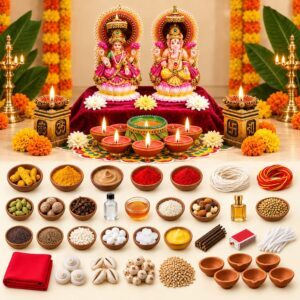
Dhanteras Puja Vidhi: Steps for Puja at Home
For Dhanteras puja at home, clean the mandir or a puja chowki (पूजा की चौकी). Arrange the pictures, flowers, water, diya and bhog. Begin with Ganesh worship, then offer prayers and puja materials to Lakshmi and Kubera. Finish with aarti and share the prasad.
Follow the steps below for a home puja with short prayers. Separate sections cover Dhanvantari worship and Yama Deepdan. If your family already follows a puja method, use that order. The prayers here accompany a shortened home ceremony.
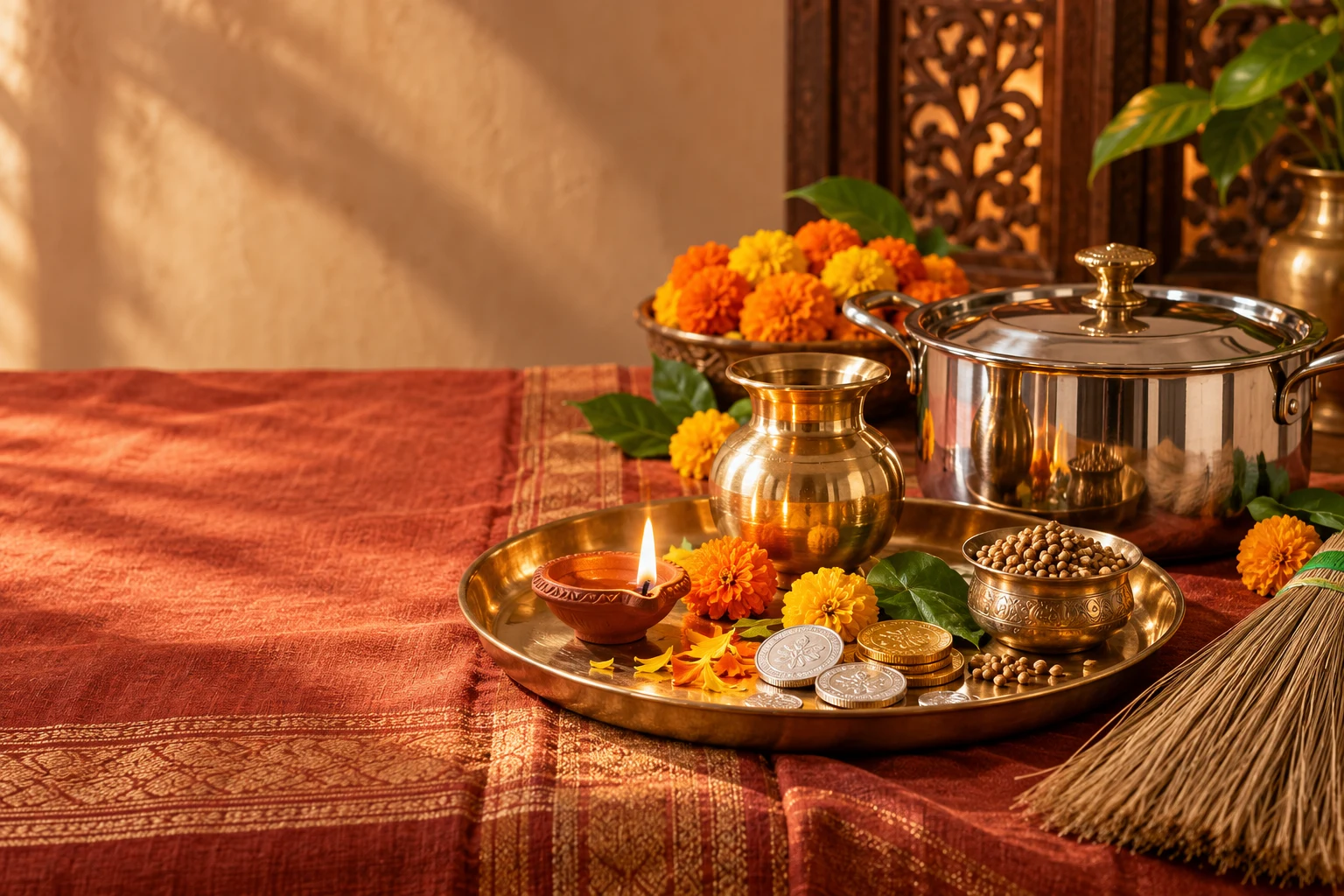
Dhanteras Puja Samagri: What to Prepare
Gather the puja samagri (पूजा सामग्री) before sitting down. Place rice and chandan in small bowls, and fruit or sweets on a separate plate.
Prepare these items:
If you will bathe a washable murti, add a tray and a soft cloth. Panchamrit (पंचामृत) is optional in these steps; use it only for a murti that you can wash.
You do not need a separate kalash installation for this sequence. If your family performs kalash puja, complete its preparation before the main worship.
Use the pictures or murtis already in your home. You do not need to buy gold, silver or a new murti for this home puja.
Which Lamps Will You Use?
The indoor diya serves the home puja. You can use it for the lamp offering and aarti if its holder allows you to lift it safely.
Prepare a separate oil diya for Yama Deepdan outside the entrance. The instructions for that lamp appear after the indoor worship sections.
How to Arrange the Pictures and Puja Materials
Clean the mandir or chowki and spread the cloth. Place the pictures upright, leaving room in front for flowers and food.
If you arrange a chowki for Dhanteras, sit facing east or north. If you worship at the existing home mandir, sit facing the murti.
Place the clean-water vessel, spoon and collection bowl together. Put the food plate away from the bowl so offered water cannot spill into the bhog.
Stand the diya on a metal plate or another heat-resistant base. Leave space between the flame and flowers, cloth or paper pictures.
If You Have a Photo or Painted Murti
Wipe a paper picture with a soft, dry cloth. Leave it dry during the water and bathing steps.
Clay, painted and wooden images also need cleaning without a water bath. Offer water before these images and pour it into the collection bowl.
If You Do Not Have a Kubera Murti
For Kubera worship, you can use a money chest (तिजोरी) or jewellery box (गहनों का डिब्बा). Place a small plate in front of it for flowers and other offerings.
Pour offered water into the collection bowl. Do not pour it over the box, money or jewellery.
When to Begin Dhanteras Puja
Choose the evening Lakshmi and Kubera puja muhurat for your city. Check the Dhanteras date and puja muhurat page for the date and local timings.
Finish arranging the pictures and materials before the puja time. Follow the separate evening instruction below for Yama Deepdan.
Dhanteras Puja at Home: From Sankalp to Aarti
Bathe, wear clean clothes and sit before the pictures or murtis. Light the indoor diya before beginning the prayers.
Start with Ganesh worship. For the Lakshmi and Kubera steps, offer each item to Lakshmi first, then Kubera. For example, offer flowers to both before moving to incense.
1. Make Your Sankalp
Begin by saying whom you are worshipping and what you are praying for. This opening statement is sankalp (संकल्प).
You can say this in your own words:
“On Dhanteras, I worship Shri Ganesh, Maa Lakshmi and Shri Kubera. Please accept my prayers and bless our home with peace and well-being.”
If you read a longer Sanskrit sankalp, check its date and tithi. Dhanteras is a Trayodashi observance; an Amavasya sankalp copied from Diwali puja needs correction.
2. Begin with Ganesh Puja
Join your palms before Ganesh and offer a flower. Offer a little chandan and a few rice grains.
Recite:
ॐ गणपतये नमः।
Om Ganapataye Namah.
Meaning: “I bow to Lord Ganesh.”
Pray for the worship to proceed without obstacles. Place the flower and rice at the base of the murti or on the plate before the picture.
Do not offer tulsi leaves to Ganesh. If you have tulsi for another part of the puja, place those leaves separately.
3. Pray to Lakshmi and Kubera
Join your palms before Maa Lakshmi and recite:
श्रीलक्ष्मीदेव्यै नमः।
Shri Lakshmi Devyai Namah.
Meaning: “I bow to Goddess Lakshmi.”
Then pray to Kubera:
ॐ श्रीकुबेराय नमः।
Om Shri Kuberaya Namah.
Meaning: “I bow to Shri Kubera.”
Ask Lakshmi and Kubera to accept the worship. You can say, “Maa Lakshmi and Shri Kubera, please accept my prayers and offerings.”
Place flowers before each image. This flower offering represents a seat, called asana (आसन), offered with respect.
4. Offer Water to Lakshmi and Kubera
Use the small spoon to take water from the clean-water vessel. For the symbolic offerings below, hold the spoon before the image without touching it. After each prayer, pour the water into the collection bowl.
Offer the water in this order:
Take clean water from the vessel for every offering. All the offered water can go into the same collection bowl.
Say “Shri Lakshmi Devyai Namah” for Lakshmi and “Om Shri Kuberaya Namah” for Kubera. Then name the offering in familiar words, such as “Please accept this water for washing your feet.”
The sipping-water offering is for the deity. You do not drink it during this step.
Leave pictures and water-sensitive murtis dry. Do not pour water from the collection bowl back into the clean-water vessel.
5. Offer Bathing Water
For a washable murti, place it in the bathing tray. Pour a little clean water over it.
If you include a panchamrit bath, mix milk, curd, ghee, honey and sugar. After offering panchamrit, rinse the murti with clean water and dry it with the soft cloth.
Do not bathe the murti if water could damage its paint or glued parts. Check these details even when the main body is metal.
For a picture or water-sensitive murti, hold a spoon of water before it. Say, “Please accept this water for bathing,” then pour the water into the collection bowl.
6. Offer Cloth, Chandan and Flowers
For a murti, drape the small clean cloth around its body without covering the face. For a picture, place the folded cloth on the plate in front.
Next, offer chandan, a few rice grains and flowers. Apply a small chandan tilak only where it will not stain or damage the murti.
For a paper picture, place the chandan and rice on the plate. Arrange the flowers at the base of the picture.
Use the Lakshmi prayer while making her offerings. Then offer the same items to Kubera with his prayer.
7. Offer Dhoop and the Diya
Hold the incense holder before the images, then return it to its place. Hold the diya before the images and return it to its base.
These are the dhoop (धूप) and deep (दीप) offerings. In this sequence, offer the lamp before bhog and perform the closing aarti afterwards.
8. Offer Bhog and Drinking Water
Place the fruit or sweet on a clean plate before the images. Bananas or a freshly prepared sweet are options for bhog.
Join your palms and say:
“Maa Lakshmi and Shri Kubera, please accept this food.”
Place the cup of drinking water beside the plate. Use clean drinking water, not water from the collection bowl.
The food offered during puja is naivedya (नैवेद्य), also called bhog. Leave it before the images until you finish the worship.
9. Perform Aarti and Close the Puja
Move the aarti lamp in clockwise circles before the images. You can sing “Om Jai Lakshmi Mata” (ॐ जय लक्ष्मी माता) for Lakshmi aarti.
If you do not know the full aarti, offer the lamp with the short prayers above. Then return the lamp to its base, join your palms and bow.
Close with a prayer in your own words:
“Please accept my worship and forgive any mistakes. Bless our home with peace and well-being.”
The Lakshmi and Kubera puja is complete. Murtis used for daily worship remain in the mandir; this puja does not require their immersion.
How to Do a Separate Dhanvantari Puja
A separate prayer for family health
Dhanvantari is a form of Vishnu associated with Ayurveda and medicine. Pray to Dhanvantari for the health of your family.
The following steps describe a separate Dhanvantari puja. Place the Dhanvantari picture or murti before you and arrange the same water, flowers, lamp and food materials.
Begin with this prayer:
श्रीधन्वन्तरये नमः।
Shri Dhanvantaraye Namah.
Meaning: “I bow to Shri Dhanvantari.”
Continue in this order:
Use “Shri Dhanvantaraye Namah” with each offering. Follow the spoon-and-bowl instructions above, leaving paper pictures dry.
You can add this personal prayer:
“Lord Dhanvantari, please bless our family with health and strength.”
If you do not have an image, join your palms and offer a personal prayer. You do not need to buy a new murti to pray to Dhanvantari.
Where to Place the Yama Deepak
Place the Yama Deepak (यम दीपक) outside the home entrance. Offer it during Pradosh Kaal (प्रदोष काल), the early evening after sunset, on Krishna Trayodashi (कृष्ण पक्ष की त्रयोदशी).
Prepare the separate oil diya with a cotton wick. Place it on a stable, heat-resistant base and light it for Yama Deepdan (यम दीपदान).
Join your palms and recite:
यमो मे प्रीयताम्।
Yamo Me Priyatam.
Meaning: “May Yama be pleased with me.”
Use one oil diya for the lamp offering described here. You do not need thirteen lamps to follow these steps.
If your family uses a particular wick arrangement or lamp direction, follow that custom. Do not treat a lamp count shared online as compulsory for every household.
Supervise the diya while it burns. Do not leave the flame unattended or go to sleep while it remains alight.
Yama Deepdan and Yama Tarpan are separate. Deepdan is the lamp offering; Tarpan (तर्पण) is a water offering and is not an extra step in this lamp prayer.
Questions About Dhanteras Puja at Home
Can I Do Dhanteras Puja Without a Priest?
+−
You can offer the household prayers described above without a priest. For a detailed ceremony, a priest can lead the Sanskrit sankalp, mantras and full sequence.
The steps here cover a shortened home puja. If your family has an established ceremony, follow its requirements.
What If I Cannot Read Sanskrit?
+−
Read the pronunciation written below each short prayer. You can make personal prayers in Hindi or another familiar language.
Say the words at a comfortable pace. These short prayers do not require eleven, twenty-one or 108 repetitions.
Is a Vrat Required on Dhanteras?
+−
Some Dhanteras traditions include a vrat (व्रत). One traditional Trayodashi observance includes eating one meal; it is different from a vrat without food or water.
Follow the food rules of the vrat you observe. Do not assume that Dhanteras puja requires every household to avoid both food and water.
Continue Planning Your Dhanteras Puja
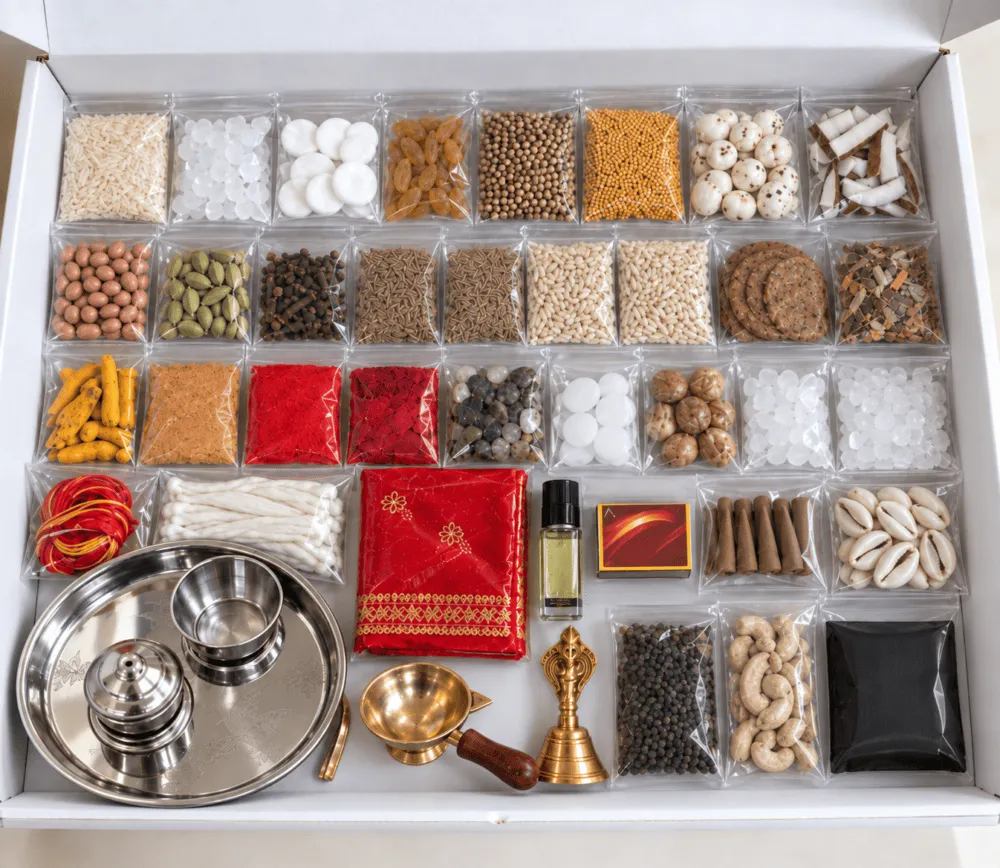
Diwali Puja Kit
Compare the organized materials with the Dhanteras samagri checklist and your family’s established worship method.