
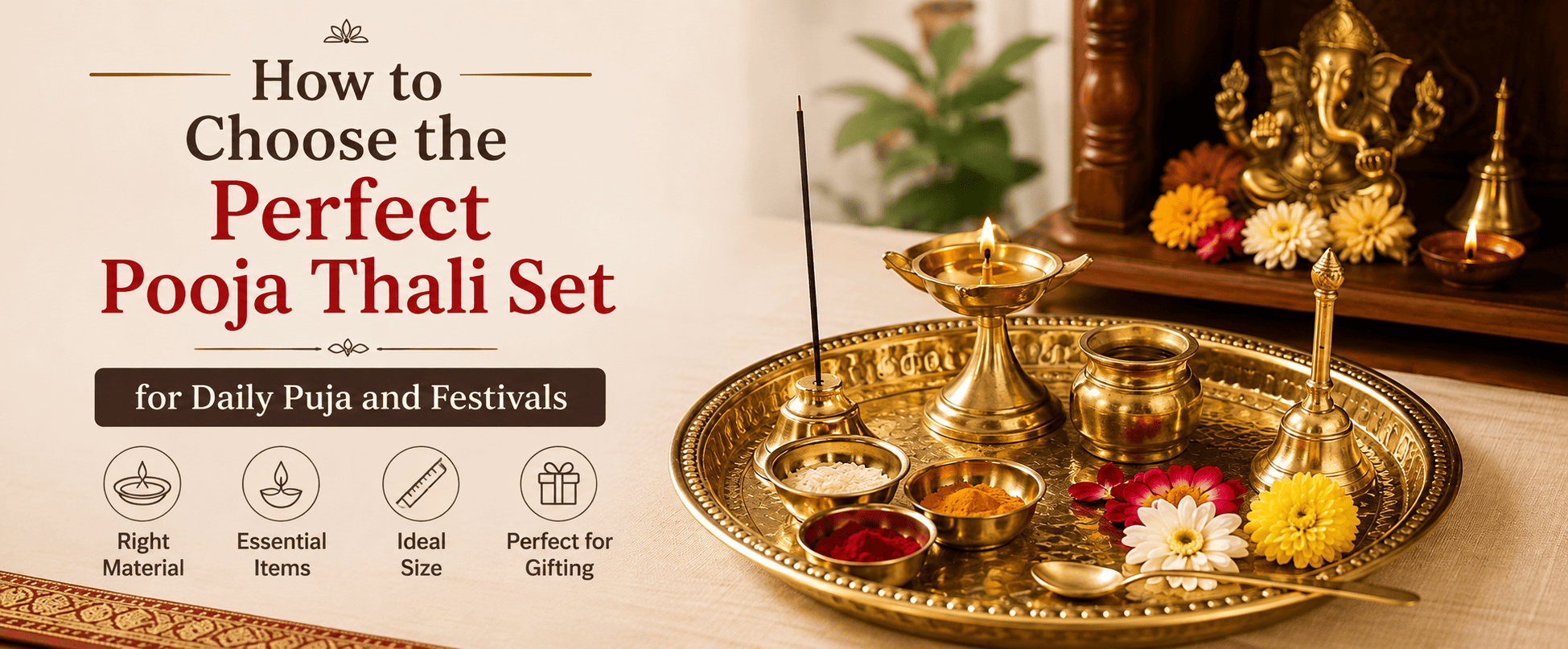








A Pooja Thali Set should make your daily worship easier, keep essential puja items organised, and suit the space where you pray. The right choice depends on four practical things: how often you perform puja, which items you normally use, the size of your home temple, and how much cleaning the material needs.
For daily puja, a simple and easy-to-handle pooja thali is usually enough. For Diwali, Navratri, Lakshmi Puja, Ganesh Chaturthi, weddings, housewarming ceremonies, and other special occasions, you may prefer a larger traditional pooja thali with separate containers, a diya, and matching puja accessories.
This guide compares materials, sizes, included items, festival needs, maintenance, and gifting options.
What Is a Pooja Thali Set?
A pooja thali set is a collection of worship accessories arranged around a puja thali, or worship plate. Depending on the design, a set may include items such as a diya, roli container, chawal container, bell, spoon, incense holder, or other puja accessories.
Traditional sets are available in different materials and styles. Some are designed for everyday worship, while others are made specifically for festivals, ceremonies, gifting, or decorative use.
The main advantage of buying a complete set is convenience. Instead of purchasing every accessory separately, you can keep commonly used items together and ready for the next puja.
Select the Right Pooja Thali Set for Daily Puja
Daily worship usually calls for practicality rather than an elaborate setup.
Pick the Thali Size Based on Available Space
A large thali can look beautiful but may be inconvenient if you have limited space in your home temple.
For daily use, consider:
- The size of your puja area
- Number of accessories required
- Storage space
- Ease of carrying the thali
- Frequency of cleaning
A medium-sized thali is often a practical choice for regular household worship.
Prioritize Durability
If you plan to use the thali every day, choose a material that can withstand regular handling and cleaning.
The thali should feel stable when placed on a flat surface. Thin or poorly finished pieces may bend or become difficult to maintain over time.
Keep the Design Practical
Decorative detailing is attractive, but excessive ornamentation can make cleaning more difficult.
For everyday use, a simple traditional pattern can offer a good balance between appearance and practicality.
Selecting a Pooja Thali Set for Diwali and Festivals
Festivals often involve more elaborate puja arrangements, so your requirements may be different.
For occasions such as Diwali, Navratri, Janmashtami, Ganesh Chaturthi, or Lakshmi Puja, you may want a larger and more decorative set.
Look for:
- A spacious thali
- Multiple small bowls
- A well-designed diya
- Decorative detailing
- Matching accessories
- A sturdy base
- Easy-to-clean surfaces
If the thali will also be used as part of your festive decoration, the design and finish become more important.
Which Material Is Best for a Pooja Thali Set?
The best material depends on how you intend to use the set.
Brass Pooja Thali
Brass is a traditional choice for Indian puja accessories and is valued for its classic appearance and durability.
Advantages:
- Traditional look
- Suitable for regular and festive use
- Durable when properly maintained
- Available in many decorative designs
- Works well as a festive gifting option
Brass can develop a darker or duller appearance over time. Regular cleaning is therefore useful if you want to maintain its shine.
Stainless Steel Pooja Thali
Stainless steel is generally chosen for convenience and everyday practicality.
Advantages:
- Easy to clean
- Resistant to everyday wear
- Lightweight options are available
- Practical for frequent use
- Usually requires less maintenance than brass
It may not provide the same traditional decorative appearance as an ornate brass set, but it can be a sensible choice for everyday worship.
Silver Pooja Thali
Silver thalis are generally associated with special occasions, gifting, and ceremonial use.
They can be elegant and valuable, but they also require appropriate care and may be considerably more expensive than brass or steel alternatives.
What Should You Look for in a Pooja Thali Set?
Choose a pooja thali based on how you will actually use it.
- For daily puja: Pick a compact, easy-to-clean thali with a diya and small containers.
- For festivals: Choose a larger set that can hold kumkum, rice, flowers, diya, incense, and other offerings.
- For traditional appearance: Brass is one of the most popular choices.
- For easy maintenance: Look for a simple design with removable accessories.
- For gifting: Choose a complete matching set with neat finishing and secure packaging.
- For a small home temple: Avoid oversized or heavily decorated sets that crowd the altar.
The best pooja thali is one that fits your mandir, daily puja items, and cleaning routine.
Start With How You Plan to Use the Pooja Thali
Before comparing designs, decide where and how often you will use the thali. This prevents you from buying an attractive set that becomes inconvenient after a few uses.
Pooja Thali Set for Daily Puja
A pooja thali set for daily puja should be simple enough to prepare, carry, clean, and store every day.
Most homes do not need a large ceremonial set for regular morning or evening worship. A practical daily thali may include:
- One main thali
- A diya
- Small containers for kumkum or roli
- A container for akshat or rice
- An incense holder
- Space for flowers or a small offering
Some families may use additional pooja thali items according to their tradition, deity, or regional customs.
For daily use, pay more attention to convenience than decoration. Heavy embellishments, deep carvings, or many loose pieces can make regular cleaning harder.
Pooja Thali Set for Festivals
A pooja thali set for festivals usually needs more space because festival worship may include additional offerings and accessories.
A larger thali can be useful for:
- Diwali and Lakshmi Puja
- Navratri
- Ganesh Chaturthi
- Janmashtami
- Raksha Bandhan rituals
- Karwa Chauth
- Satyanarayan Puja
- Housewarming ceremonies
- Wedding rituals
Your family tradition should always decide what goes on the thali. There is no single list that applies to every Hindu puja.
Which Pooja Thali Material Is Best?
Material affects appearance, weight, maintenance, durability, and price. Compare these factors instead of choosing only by colour or decoration.
| Material | Best For | Main Advantage | Consider Before Buying |
| Brass | Daily puja, festivals, gifting | Traditional appearance and durability | Needs regular cleaning to maintain its finish |
| Stainless steel | Everyday use | Easy to clean and practical | Less traditional in appearance than brass |
| Copper | Traditional puja use | Distinct traditional finish | Needs proper care and regular cleaning |
| Silver or silver-plated | Festivals and gifting | Decorative and premium appearance | Usually needs more careful handling |
| Decorative mixed-material sets | Occasional use and gifting | Wide choice of colours and designs | Check durability and cleaning instructions |
Check Which Pooja Thali Items Are Included
Do not choose a set simply because the product title mentions a high number of pieces. Check what those pieces actually are.
Depending on the design, a set may include:
- Main pooja thali
- Diya
- Kumkum or roli container
- Akshat container
- Small bowls
- Incense holder
- Bell
- Kalash
- Spoon
- Panchpatra
- Small lota
- Decorative containers
You may not need every item.
For example, if you already own a bell, kalash, and incense stand, a smaller thali with useful containers may offer better value than another large set containing duplicate accessories.
A good pooja thali buying guide therefore starts with your existing puja items, not the number printed on the product box.
Choose the Right Size for Your Home Temple
The pooja thali should fit comfortably in your mandir or puja area without blocking idols, lamps, or other items.
Consider three things before choosing the size:
Your altar space: A compact wall-mounted mandir needs a smaller thali than a large dedicated puja room.
Number of items: A diya, two small containers, and flowers need less space than a complete festival arrangement.
How you perform aarti: If you regularly lift and move the thali during aarti, choose a size and weight you can hold comfortably.
Leave enough open space between the diya and loose flowers, cloth, packaging, or other flammable materials.
Look Closely at the Diya and Small Containers
The main thali often gets most of the attention, but the smaller pieces can determine how convenient the set feels.
Check whether the diya sits steadily on the tray. It should not wobble easily when you move the thali.
The kumkum, haldi, or rice containers should also be easy to pick up and clean. Very tiny decorative containers can look attractive in photographs but may be less useful during regular worship.
Removable pieces are usually easier to clean than accessories permanently fixed to the thali.
How to Choose a Pooja Thali Set for Diwali?
A pooja thali set for Diwali should give you enough room to arrange the items your family uses for Lakshmi Puja or aarti.
Depending on your family practice, the thali may hold a diya, kumkum, akshat, flowers, incense, sweets, and other offerings.
For Diwali, consider:
- Enough space for your required puja items.
- A stable place for the diya.
- Separate containers for powders and rice.
- A finish that is easy to clean after oil or ghee use.
- A design you can comfortably carry during aarti.
A decorative thali can add to the festive presentation, but usability should remain the first priority.
Need the Puja Items Along With Your Thali?
A thali keeps your worship items organised, but you still need the essentials used during daily puja. Satvikly also offers a daily puja kit with commonly used puja samagri, which can help you prepare your home mandir without buying each basic item separately.
Traditional Pooja Thali or Decorative Pooja Thali?
A traditional pooja thali usually focuses on familiar materials such as brass, copper, or steel and practical puja accessories.
Decorative sets may use colourful work, beads, fabric, stones, painted details, or festive patterns.
Choose a traditional design when you want:
- Regular long-term use
- Easier coordination with existing puja items
- A timeless look
- A suitable option for religious gifting
Choose a decorative design when the thali will mainly be used for a particular festival, wedding function, gift, or special ceremony.
For frequent use, check how easily decorative sections can be cleaned before buying.
Buying a Pooja Thali Set as a Gift
Pooja thali sets are commonly considered for weddings, housewarming celebrations, festive gifting, and gifts for newly married couples.
When buying for someone else, avoid making the choice too personal or ritual-specific unless you know their family customs.
A versatile gift set usually has:
- A clean traditional design
- Commonly useful puja accessories
- A manageable size
- Good finishing
- Secure storage or gift packaging
A brass set can be a practical choice when the recipient prefers traditional puja accessories and classic home-temple items.
Set Your Budget Before Comparing Pooja Thalis
Pooja thali prices can vary based on the material, size, number of accessories, decorative work, finishing, and packaging. A higher piece count does not always mean better value.
For daily puja, a simple set with the items you regularly use may be enough. For festivals or gifting, you may want a larger or more decorative set.
Before buying, compare the material, thali size, included accessories, build quality, and actual usefulness rather than choosing only by price.
Check Quality Before You Buy
Product photographs can make two sets look almost identical even when their build quality differs.
Before ordering, check:
Finish
Look for smooth edges, balanced construction, and clean finishing. Poorly finished edges can make a frequently handled thali uncomfortable to use.
Weight
Very heavy sets can be inconvenient during aarti. Extremely lightweight sets may move easily when small accessories are placed on them.
Choose a weight suitable for the person who will use it most often.
Stability
The diya, bowls, and containers should sit properly without tipping easily.
Cleaning
Check whether individual parts can be removed and washed separately.
Actual Set Contents
Read the complete product description. Decorative flowers, idols, sweets, incense, or other items shown in photographs may not always be included.
Common Pooja Thali Buying Mistakes
A few simple checks can prevent disappointing purchases.
Buying only for appearance: A heavily decorated set may not suit everyday cleaning.
Choosing the biggest set: More pieces do not automatically make a set better.
Ignoring your mandir size: An oversized thali can make a small puja area difficult to use.
Not checking included items: Compare the actual accessories instead of relying on the piece count.
Ignoring maintenance: Brass, copper, plated finishes, and decorative work require different levels of care.
Using one list for every puja: Required items can differ by family tradition, region, deity, and ceremony.
Which Pooja Thali Set Is Right for You?
The easiest way to decide is to match the thali to its main purpose.
- Choose a simple pooja thali for everyday prayer if you want quick setup and cleaning.
- Choose a brass pooja thali set when traditional appearance and long-term use matter most.
- Choose a larger pooja thali set for festivals when you regularly arrange several offerings and accessories.
- Choose a coordinated decorative set when presentation matters for gifting, weddings, or special celebrations.
You do not need the most elaborate set. You need one that makes your puja space organised and comfortable to use.
Choose a Pooja Thali That Fits Your Puja Routine
The Pooja Thali Set is not necessarily the biggest or most decorative option. It should fit your home temple, hold the puja items you actually use, feel comfortable during aarti, and be practical to maintain.
For everyday worship, keep the set simple. For festivals, choose more space and useful accessories. If you are looking for a traditional option for daily puja, festivals, or gifting, explore pooja thali sets at Satvikly and compare the size, material, and included accessories with your needs.
FAQs About Pooja Thali Sets
What should a pooja thali contain?
Common pooja thali items may include a diya, kumkum or roli, rice, flowers, incense, and small containers. The exact items depend on your family tradition and the puja being performed.
Which material is best for a pooja thali?
Brass is popular for a traditional appearance and repeated use. Stainless steel is practical for easy maintenance, while copper and silver-finish sets suit buyers seeking other traditional or decorative options.
Is a brass pooja thali good for daily puja?
Yes. A brass pooja thali can work well for daily worship if its size and weight are comfortable. Keep in mind that brass requires periodic cleaning to maintain its appearance.
What should I look for in a pooja thali set for daily puja?
Choose a manageable size, stable diya, useful containers, smooth finishing, and easy-to-clean design. Avoid unnecessary accessories if they make daily preparation harder.
What type of pooja thali is best for Diwali?
Choose a thali large enough for the items your family uses during Diwali puja. A stable diya area, small containers, and easy cleaning are more useful than decoration alone.
Can a pooja thali set be given as a wedding gift?
Yes. Traditional pooja thali sets are suitable for many wedding and housewarming gifts. A simple coordinated design is usually easier for the recipient to use across different occasions.
How do I choose between a small and large pooja thali?
Choose according to your mandir space and the number of items you regularly use. Small sets suit daily worship and compact temples, while larger sets provide more room for festival arrangements.