Diwali Puja 2026: Vidhi, Samagri, Mantras, Muhurat and Aarti
During Diwali Puja, you worship Maa Lakshmi and Lord Ganesh. You pray for good health and wealth for your family. In Sankalp (संकल्प), you state why you are doing the Puja.
Check the date and Diwali Puja Muhurat (मुहूर्त), or Puja time, for your city. Arrange the Diwali Puja Samagri (सामग्री) before you sit for worship. Read the mantras as you follow the worship steps. After Aarti and the closing prayer, share Prasad with your family.
What Is Diwali Puja and Who Do You Worship
During Diwali Puja, you worship Maa Lakshmi and Lord Ganesh. You worship Ganesh first, then offer prayers and offerings (भेंट) to Lakshmi.
Maa Lakshmi is also called Shri (श्री), the goddess of wealth (धन). You also worship her as Grihalakshmi (गृहलक्ष्मी), the goddess of the home. Prayers to Shri ask her to stay with the family.
Ganesh has the right to receive worship before other gods. Shiva and the other gods grant him this place. You begin with Ganesh Puja and pray for help in completing the worship.
Indra follows this order when worshipping Lakshmi. He worships Ganesh and five other gods first. He then invites Mahalakshmi to receive worship, a step called Avahan (आवाहन).
Praying for Family Wellbeing and Wealth During Diwali Puja
During Diwali Puja, you pray for the needs of your family. Prayers to Lakshmi include requests for:
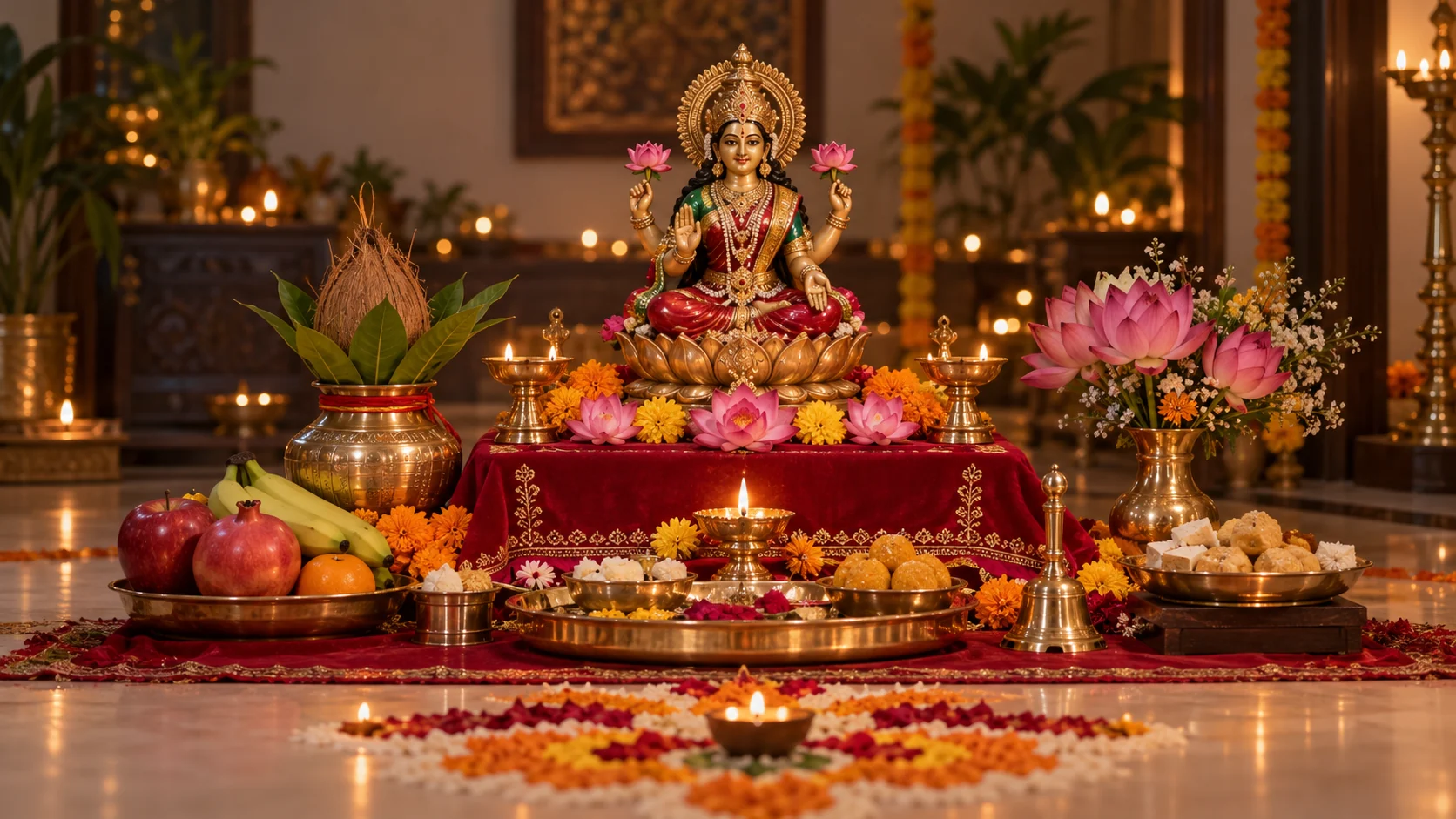
The Shri Sukta asks Lakshmi to stay with the family. At home, you honour her as Grihalakshmi (गृहलक्ष्मी), the goddess of the home. The Devi Bhagavata prayer includes knowledge and Dharma alongside wealth.
In your Sankalp (संकल्प), say why you are doing the Puja. You can name a specific need, such as the health of a family member or work to support the household. When offering Bhog (भोग), you can give thanks for what your family has to eat.
Why Lakshmi Puja Takes Place on Amavasya Night
Amavasya (अमावस्या) is the new moon day. In the Skanda Purana, you worship Maa Lakshmi during Pradosh on the Amavasya of Diwali.
Amavasya and the Time for Lakshmi Puja
Pradosh Kaal (प्रदोष काल) is the evening period after sunset. For household Lakshmi Puja, the preferred time falls when Amavasya continues during Pradosh.
Jyotish (ज्योतिष) also considers Sthir Lagna (स्थिर लग्न). Lagna is the zodiac sign (राशि) rising in the east at a particular time. Sthir is a category of signs that includes Vrishabha (वृषभ), or Taurus. Families choose this period with the prayer that Lakshmi stays in the home.
Pradosh Muhurat is an evening worship time. Nishita Muhurat (निशीथ मुहूर्त) falls around the middle of the night. Household Lakshmi Puja commonly takes place during Pradosh. Some Tantric traditions (तांत्रिक परंपराएँ) also have midnight Lakshmi worship.
Lakshmi and Samudra Manthan
During Samudra Manthan (समुद्र मंथन), the gods and Asuras (असुर) stir the Milk Ocean (क्षीरसागर) to obtain Amrit (अमृत). Lakshmi appears from the ocean holding a lotus. Rishis (ऋषि) welcome her with the Shri Sukta.
This is the Puranic account of her appearance from the ocean. The Diwali date follows the rule for Amavasya evening worship.
Worshipping Lakshmi as Shakti
In Shakti Puja (शक्ति पूजा), you worship God as the Mother Goddess (जगन्माता). Maa Lakshmi is one form of the Divine Mother.
Shakti (शक्ति) is her divine power. God and Shakti are inseparable, like fire and its power to burn. In Bengal, worshippers honour Maa Kali during the Amavasya midnight period of the Diwali festival.
Welcoming Lakshmi and Sending Away Alakshmi
Alakshmi (अलक्ष्मी) stands for bad fortune (दुर्भाग्य), including hunger and poverty. Prayers to Lakshmi ask for Alakshmi to leave the home.
In one Diwali custom, women beat small drums and a Soop (सूप), a basket for cleaning grain, after midnight. The purpose is to drive Alakshmi from the home yard (आँगन).
You welcome Lakshmi by lighting diyas and offering prayers. A Diwali prayer honours her in the flame of a lamp.
Diwali Puja 2026 Date and Muhurat for Lakshmi Worship
Diwali Puja will be celebrated on Sunday, November 8, 2026. Worship Maa Lakshmi during the Puja time listed for your city. All times are in Indian Standard Time (IST).
| City | Evening Lakshmi Puja Muhurat (मुहूर्त) |
|---|---|
| New Delhi | 5:54 PM to 7:50 PM |
| Noida | 5:54 PM to 7:49 PM |
| Mumbai | 6:27 PM to 8:27 PM |
| Kolkata | 5:20 PM to 7:18 PM |
| Bengaluru | 6:17 PM to 8:20 PM |
| Chennai | 6:07 PM to 8:09 PM |
| Hyderabad | 6:07 PM to 8:08 PM |
| Jaipur | 6:03 PM to 7:59 PM |
If your city is not listed, check the Puja time for your city in the Panchang (पंचांग).
Amavasya Tithi (अमावस्या तिथि)
Amavasya continues into November 9, but Lakshmi Puja for the listed cities is on November 8 evening.
How to Prepare for Diwali Puja at Home
Arrange the Diwali Puja Samagri (सामग्री) before you sit for worship. Wash and dry the Puja Thali (पूजा थाली), bowls and spoon. Prepare a separate bowl of Gangajal (गंगाजल) with a spoon for offerings during Puja. Bathe and wear clean clothes before worship.
Where to Perform the Puja at Home
Use your home Mandir or a clean space where family members can sit. Clean the floor and the shelf or table for the Lakshmi and Ganesh Murti or photo.
A Chowki (चौकी) is a small table for worship. Place it where it does not wobble, then cover it with a clean cloth. Place your Asan (आसन), or Puja mat, in front of the Chowki.
Sit facing east (पूर्व) or north (उत्तर). If the Murti is permanently installed in your home Mandir, sit facing it.
Place the Diya on a heatproof plate, away from cloth and paper. Arrange the offering plates within reach, without having to lean over the flame. Leave a walkway so family members need not step over Puja items.
Prepare the Murti or Photo Before Worship
Remove old flowers from the worship area. Dust the Lakshmi and Ganesh Murti (मूर्ति), its base or the photo frame with a soft, dry cloth.
- Clay or painted Murti: Do not pour Gangajal, water or Panchamrit over it. Do not scrape dried Roli or Chandan off the paint.
- Photo: Wipe the frame gently. Leave the printed picture dry, and place wet offerings on a separate plate.
- Murti used for Snan: Snan (स्नान) is a bath offered during worship. For a plain metal Murti used for bathing, arrange a wide bowl to hold it and collect the liquids. Do not bathe a Murti with paint or glued decorations. If offering Panchamrit (पंचामृत), prepare clean water for rinsing afterwards and a soft cloth for drying. Panchamrit contains milk, curd, ghee, honey and sugar.
Diwali Puja Samagri List and the Purpose of Each Item
Check the Diwali Puja items already available at home. Arrange the remaining items before Puja day. Prepare fresh flowers, leaves and Bhog separately from the packed items.
Water Offerings and Snan Items
- Clean water (स्वच्छ जल)
- Gangajal (गंगाजल)
- Rose water (गुलाब जल)
- Milk (दूध)
- Curd (दही)
- Honey (शहद)
- Sugar (चीनी)
Water offered for washing the feet of Lakshmi and Ganesh is called Padya (पाद्य). Arghya (अर्घ्य) is a water offering made with respect. Achamaniya (आचमनीय) is water offered for rinsing the mouth.
For Lakshmi Arghya, Gangajal can be combined with flowers, Chandan and Durva. Rose water serves as scented water in family practices that include it.
Milk, curd, honey, sugar and ghee form Panchamrit (पंचामृत). Arrange these ingredients when your Puja includes Snan (स्नान), the ritual bath. Use clean water to rinse the Murti after Panchamrit Snan.
Tilak, Clothes and Puja Threads
- Roli (रोली)
- Chandan (चंदन)
- Sindoor (सिंदूर)
- Akshat (अक्षत)
- Janeu (जनेऊ)
- Mauli or Kalawa (मौली या कलावा)
- Red cloth (लाल कपड़ा)
- Cloth offered to Lakshmi and Ganesh (लक्ष्मी गणेश को अर्पित करने का वस्त्र)
Roli is used for Tilak, and Chandan is offered as sandalwood paste. Offer unbroken rice grains, called Akshat, with prayers. Sindoor is an offering in Ganesh worship and some family forms of Lakshmi Puja.
Janeu is the sacred thread offered during Ganesh Puja. Some families offer Mauli in place of clothing for Lakshmi. Follow this substitution only if it forms part of your family practice.
The red cloth covers the Chowki. Clothing offered to Lakshmi and Ganesh is a separate offering.
Flowers, Leaves and Bhog
- Fresh flowers and garlands (ताजे फूल और माला)
- Lotus, if available (कमल)
- Durva grass (दूर्वा)
- Bilva leaves or fruit (बिल्वपत्र या बिल्वफल)
- Seasonal fruit (मौसमी फल)
- Coconut (नारियल)
- Sweets or Kheer (मिठाई या खीर)
- Mixed dry fruit or Panchmeva (पंचमेवा)
- Sugar crystals or Mishri (मिश्री)
- Popped rice or Kheel (खील)
- Sugar sweets or Batasha (बताशा)
- Paan leaves (पान के पत्ते)
- Supari (सुपारी)
- Elaichi (इलायची)
- Laung (लौंग)
Offer fresh flowers and garlands to Lakshmi and Ganesh. Maa Lakshmi is worshipped seated on a lotus, and lotus flowers are offered to her. Fresh seasonal flowers can also be used.
Durva is offered to Ganesh. Bilva leaves or fruit are included in some family traditions of Lakshmi worship.
Fruit, coconut, sweets, dry fruit, Mishri, Kheel and Batasha form the Bhog (भोग). After worship, share the edible offerings as Prasad (प्रसाद). Elaichi and Laung can flavour milk-based sweets offered to Lakshmi.
After Bhog, offer Paan and Supari as Tambul (ताम्बूल), the betel offering. Elaichi can also form part of this offering.
Diyas, Fragrance and Aarti Items
- Diyas (दीये)
- Cotton wicks (रुई की बत्ती)
- Ghee (घी)
- Sesame oil (तिल का तेल)
- Dhoop (धूप)
- Itra (इत्र)
- Kapoor (कपूर)
- Matches (माचिस)
- Bell (घंटी)
- Heatproof Aarti plate (आरती की थाली)
- Dhoop holder (धूपदान)
Cotton wicks burn using the ghee or oil in the Diya. Dhoop is burned as an incense offering, while Itra is offered for fragrance. Place fragrance bottles separately from edible offerings.
Use a lit Diya or Kapoor for Aarti, following your family practice. The Aarti plate holds the Diya or camphor, and the bell is rung during worship. Matches light the lamps, Dhoop and Kapoor.
Coins and Symbols for Lakshmi Worship
- Silver coin or an ordinary coin (चाँदी का सिक्का या सामान्य सिक्का)
- Currency notes (रुपये के नोट)
- Lakshmi Yantra (लक्ष्मी यंत्र)
- Kuber Yantra (कुबेर यंत्र)
- Lakshmi Charan Paduka (लक्ष्मी चरण पादुका)
- Swastik (स्वस्तिक)
Coins and currency notes are included in Dhan Puja (धन पूजा), the worship of wealth. A silver coin is an option, not a requirement for every home.
A Yantra is a diagram used in worship. Lakshmi Yantra is used for Lakshmi worship, and Kuber Yantra for Kuber worship.
Lakshmi Charan Paduka represents the feet of Maa Lakshmi. Swastik is a sacred symbol placed or drawn at the worship place.
Items Used in Some Family Traditions
- Haldi or turmeric (हल्दी)
- Dhaniya or coriander seeds (धनिया)
- Sarson or mustard seeds (सरसों)
- Jeera or cumin seeds (जीरा)
- Jau or barley (जौ)
- Gomti Chakra (गोमती चक्र)
- Kaudi or cowrie shells (कौड़ी)
- Kamal Gatta or lotus seeds (कमलगट्टा)
Some families place Haldi, Dhaniya and loose Kamal Gatta with the money being worshipped. Kaudi and Gomti Chakra also form part of household customs.
For Sarson, Jeera and raw Jau, ask your Pandit Ji which offering requires them. Do not mix these seeds into Bhog merely because a kit includes them. Loose Kamal Gatta seeds differ from a threaded Japa Mala (जपमाला), which counts mantra repetitions.
Puja Images and Utensils
- Lakshmi and Ganesh Murti or photo (लक्ष्मी गणेश की मूर्ति या तस्वीर)
- Chowki (चौकी)
- Sitting mat or Asan (आसन)
- Puja Thali (पूजा थाली)
- Small bowls (छोटी कटोरियाँ)
- Water vessel (जलपात्र)
- Spoon (चम्मच)
- Bowl for Snan (स्नान का पात्र)
- Soft drying cloth (पोंछने का मुलायम कपड़ा)
The Chowki holds the Murti or photo, and the Asan provides a seat for worship. Use the Thali and small bowls to separate the offerings.
Offer water using the water vessel and spoon. If Snan is included, the larger bowl collects bathing liquids, and the soft cloth dries the Murti.
See the full Samagri list with quantities before buying the remaining items.
Diwali Puja Vidhi at Home From Sankalp to Aarti
Begin the Diwali Puja Vidhi with Sankalp (संकल्प), followed by Ganesh Puja. Start these opening steps earlier if needed. Worship Maa Lakshmi during the Lakshmi Puja Muhurat (मुहूर्त) listed for your city.
Take the Sankalp
Place an empty bowl beside the clean water. Use this bowl to collect water offered during the Puja.
Take a little water, unbroken rice and a flower in your right palm. Say your name, the place of worship and why you are doing the Puja. In Sankalp, you say which worship you will perform and its purpose.
Diwali Puja Sankalp in Hindi
Use this example with your name and place:
मेरा नाम [नाम] है। मैं [स्थान] में दिवाली पर माँ लक्ष्मी और भगवान गणेश की पूजा का संकल्प लेता/लेती हूँ। कृपया मेरी पूजा स्वीकार करें और मेरे परिवार को स्वास्थ्य, अन्न और काम का आशीर्वाद दें।
Choose लेता or लेती when speaking. After the Sankalp, release the water, rice and flower into the empty bowl.
Worship Ganesh First
Bow to Ganesh and recite:
ॐ गं गणपतये नमः।
Om Gam Ganapataye Namah
I bow to Lord Ganesh.
Hold a spoon of water before Ganesh as an offering. Pour it into the bowl for offered water. Offer Chandan, Akshat, flowers and Durva at the feet of the Murti.
For a photo, place these offerings on a small plate before it. Offer Dhoop, then hold the lit Diya before Ganesh. Place a small Bhog offering before him to complete this short Ganesh Puja.
Welcome Maa Lakshmi
Fold your hands and look at the Lakshmi Murti or photo. Remember Maa Lakshmi as you recite:
ॐ श्रीमहालक्ष्म्यै नमः।
Om Shri Mahalakshmyai Namah
I bow to Maa Mahalakshmi.
Offer a welcome prayer in your own words. You can ask Maa Lakshmi to accept the worship and offerings you have prepared.
Offer a Seat and Water
Place flowers before the Murti or photo as Asan (आसन), the seat offered to Maa Lakshmi. Then offer water for each of the following purposes:
- Padya (पाद्य): Water offered for washing her feet.
- Arghya (अर्घ्य): Water offered to honour her.
- Achamaniya (आचमनीय): Water offered for rinsing her mouth.
For each offering, hold a spoon of water before the image. Name the offering, then pour the water into the receiving bowl. For example, ask Maa Lakshmi to accept Padya before releasing that water.
These are offerings to Maa Lakshmi. Do not pour water onto a photo.
Offer Snan
Snan (स्नान) is the bath offered during worship. Choose the option that matches the image you have prepared.
For a plain metal Murti without paint or glued parts: Place it inside a bowl that collects the bathing liquids. Offer water first. If your Puja includes Panchamrit, offer it next and rinse with clean water. Dry the Murti with a soft cloth before returning it to the Chowki.
For a photo, clay Murti or painted Murti: Leave the image dry. Offer the bath through prayer. You can say, “Maa Lakshmi, please accept this bath,” without pouring liquids over the image.
Offer Clothes, Tilak and Akshat
Offer a small clean cloth to Maa Lakshmi. Dress the Murti if your family follows this practice, or place the cloth before her as an offering.
Offer Chandan and Roli, followed by Akshat, the unbroken rice grains. Apply a small Tilak only where the Murti can receive the paste without damage.
For a photo, place the cloth, Chandan, Roli and rice before it. Leave the printed picture dry.
Offer Flowers
Place flowers at the feet of the Murti or on the offering plate before the photo. Recite:
ॐ श्रीमहालक्ष्म्यै नमः। पुष्पं समर्पयामि।
Om Shri Mahalakshmyai Namah. Pushpam Samarpayami.
I bow to Maa Mahalakshmi and offer flowers.
If you have a garland, place it around the Murti or frame. Leave the face uncovered.
Offer Dhoop and the Diya
Hold the burning Dhoop in its holder before Maa Lakshmi. After offering it, put the holder back on its plate.
Next, hold the lit Diya before the Murti or photo. Return it to its heatproof plate after the offering. The closing Aarti comes in Step 11.
Offer Bhog
Place the prepared Bhog plate before Lakshmi and Ganesh. Bhog is also called Naivedya (नैवेद्य), an offering of fruit, sweets or a prepared dish.
Fold your hands and ask Lakshmi and Ganesh to accept the offering. Leave the plate before the images until worship is complete.
Offer Water and Tambul
After Bhog, offer water to Lakshmi and Ganesh for drinking and rinsing the mouth. Hold the spoon before the images, then pour the water into the receiving bowl.
Place Paan leaves and Supari on the offering plate. This is Tambul (ताम्बूल), the betel offering.
Offer Ganesh and Lakshmi Aarti
Sing Ganesh Aarti, followed by Lakshmi Aarti. Hold the Aarti plate and move the lamp clockwise before the images.
Ring the bell, or ask another family member to ring it. After Aarti, put the plate back in its prepared place, away from cloth and paper.
Close With Prayer and Share Prasad
Offer flowers, fold your hands and bow. Ask forgiveness for mistakes during worship. This prayer is called Kshama Prarthana (क्षमा प्रार्थना).
You can pray:
माँ लक्ष्मी और भगवान गणेश, पूजा में हुई भूलों को क्षमा करें। कृपया मेरी पूजा स्वीकार करें।
After the closing prayer, share the edible offerings as Prasad (प्रसाद). Serve the fruit, sweets and prepared dishes to the family members attending.
Lakshmi and Ganesh Puja Mantras With Hindi Meanings
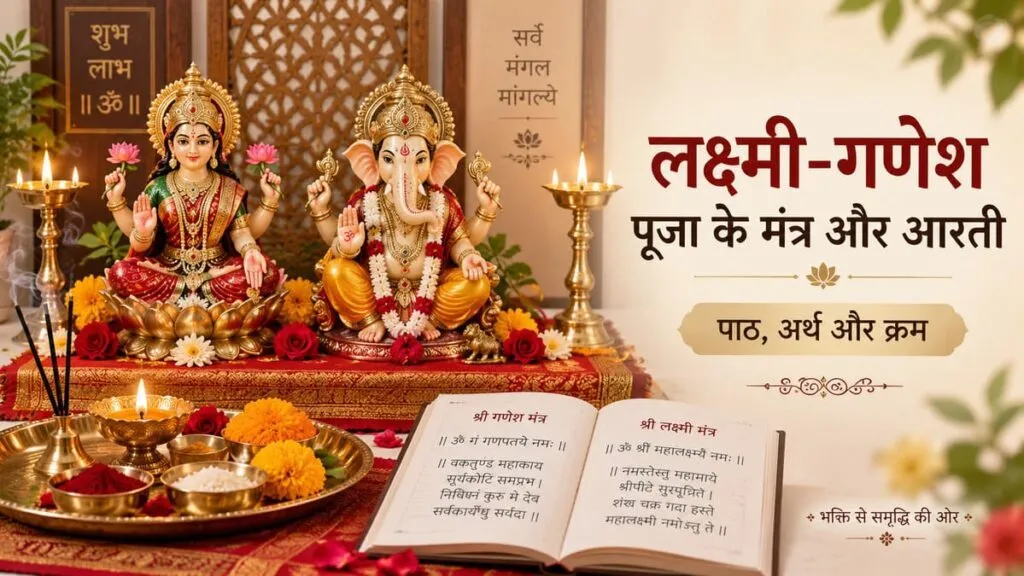
With Namah (नमः), you offer a respectful bow to Ganesh or Maa Lakshmi. Ganesh Gayatri asks for wisdom (सद्बुद्धि), and Shri Sukta welcomes Maa Lakshmi.
Ganesh Namaskar Mantra
ॐ गं गणपतये नमः।
Om Gam Ganapataye Namah.
सरल हिंदी अर्थ: भगवान गणेश को मेरा प्रणाम।
Recite this mantra while offering flowers or Durva (दूर्वा) to Ganesh.
Ganesh Gayatri Mantra
एकदन्ताय विद्महे वक्रतुण्डाय धीमहि।
तन्नो दन्तिः प्रचोदयात्॥
Ekadantaya Vidmahe Vakratundaya Dhimahi.
Tanno Dantih Prachodayat.
संक्षिप्त हिंदी अर्थ: हम एक दाँत और मुड़ी हुई सूँड वाले गणेशजी का ध्यान करते हैं। गणेशजी हमारी बुद्धि को सही दिशा दें।
Opening Verse of Shri Sukta
ॐ हिरण्यवर्णां हरिणीं सुवर्णरजतस्रजाम्।
चन्द्रां हिरण्मयीं लक्ष्मीं जातवेदो म आवह॥
Om Hiranyavarnam Harinim Suvarnarajatasrajam.
Chandram Hiranmayim Lakshmim Jatavedo Ma Avaha.
सरल हिंदी अर्थ: हे अग्निदेव, सोने जैसी चमक वाली माँ लक्ष्मी को मेरे पास बुलाएँ। वह सोने और चाँदी की मालाएँ पहनती हैं और चाँद जैसी चमकती हैं।
Jatavedas (जातवेदस्) is a name for Agni (अग्नि), the fire god.
Lakshmi Pranam Shloka
नमः कमलवासिन्यै नारायण्यै नमो नमः।
कृष्णप्रियायै सततं महालक्ष्म्यै नमो नमः॥
Namah Kamalavasinyai Narayanyai Namo Namah.
Krishnapriyayai Satatam Mahalakshmyai Namo Namah.
सरल हिंदी अर्थ: कमल में रहने वाली नारायणी माँ लक्ष्मी को बार-बार प्रणाम। श्रीकृष्ण की प्रिय माँ महालक्ष्मी को सदा प्रणाम।
You can read this Shloka during Lakshmi prayers before Aarti (आरती).
What to Offer as Bhog to Lakshmi and Ganesh
Offer fresh sweets or washed fruit to Lakshmi and Ganesh. This offering is called Bhog (भोग) or Naivedya (नैवेद्य).
Kheel (खील), or puffed rice, is also known as Laja (लाजा), an offering used in Ganesh worship. Batasha (बताशे), small sugar sweets, are also traditional Diwali offerings. Choose from these offerings according to your family custom and budget.
Bhog for Maa Lakshmi
You can offer rice Kheer (खीर) made with milk and sugar. This sweet rice dish is also called Paramanna (परमान्न).
You can also offer milk Laddus (दूध के लड्डू) to Lakshmi on Diwali. Fresh fruit and Gur (गुड़), or jaggery, are other choices.
Bhog for Lord Ganesh
Offer Modak (मोदक), a sweet dumpling, to Lord Ganesh.
Place the Bhog on a clean plate or in a bowl in front of Lakshmi and Ganesh. Then offer drinking water in a separate cup. After the Puja, share the Prasad (प्रसाद) with your family.
How to Perform Lakshmi Puja in Shops and Offices
Some businesses worship their account books during Bahi Khata Puja (बही खाता पूजा). These books record sales, purchases and payments. In Gujarat, this worship is called Chopda Puja (चोपड़ा पूजा).
Check the Lakshmi Puja Muhurat (मुहूर्त) for the city where you will worship. For Chopda Puja, follow the local timing used in your business tradition.
Bahi Khata and Chopda Puja
Place the business account book and a pen beside the Lakshmi and Ganesh Murti or photo. Include the cash box if your business follows Kuber Puja. Place the Diya away from account books and loose paper.
In your Sankalp (संकल्प), mention the business name and why you are doing the Puja. Pray for income (आय) and honesty (ईमानदारी) in business.
Begin with Ganesh Puja, then worship Maa Lakshmi. Use the offerings and mantras from the earlier Ganesh and Lakshmi Puja steps.
Place the account book in front of you and pray to Maa Saraswati. Offer flowers and Akshat (अक्षत), or unbroken rice, beside the book. Draw a Swastik (स्वस्तिक) on the book if this is your custom.
Offer Bhog (भोग), then perform Aarti (आरती). Share Prasad (प्रसाद) with everyone who joins the Puja.
Chopda Puja With Digital Accounts
If you use a laptop for business accounts, you can include it in Chopda Puja. Place flowers and rice on a separate plate beside the laptop. Set the bowls of water and Tilak paste away from the laptop.
Diwali Night Customs Beyond the Main Puja
On Diwali night, light Diyas at the front door and near the home Mandir. Rows of Diyas are called Deep Malika (दीपमालिका).
Some families stay awake for prayers on Diwali night. This custom is called Jagaran (जागरण). Read Shri Sukta or prayers to Maa Lakshmi. You can also read a few verses (श्लोक) from the Bhagavad Gita or a Purana (पुराण). You can sing Bhajans (भजन), or songs about God, together.
Annadaan (अन्नदान) is giving a meal to someone who needs it. You can cook a meal to share or help serve meals at a temple.
Lakshmi and Ganesh Aarti With Hindi Lyrics
After offering Bhog (भोग), sing Ganesh Aarti, then Lakshmi Aarti. Hold the Aarti Thali (आरती की थाली) in front of the Murti or photo. Move it clockwise (घड़ी की सुइयों की दिशा में).
Ganesh Aarti Jai Ganesh Deva
जय गणेश, जय गणेश, जय गणेश देवा।
माता जाकी पार्वती, पिता महादेवा॥
एकदन्त दयावन्त, चार भुजाधारी।
माथे पर तिलक सोहे, मूसे की सवारी॥
जय गणेश, जय गणेश, जय गणेश देवा।
माता जाकी पार्वती, पिता महादेवा॥
पान चढ़े फूल चढ़े, और चढ़े मेवा।
लड्डुअन का भोग लगे, सन्त करें सेवा॥
जय गणेश, जय गणेश, जय गणेश देवा।
माता जाकी पार्वती, पिता महादेवा॥
अँधे को आँख देत, कोढ़िन को काया।
बाँझन को पुत्र देत, निर्धन को माया॥
जय गणेश, जय गणेश, जय गणेश देवा।
माता जाकी पार्वती, पिता महादेवा॥
सूर श्याम शरण आए, सफल कीजे सेवा।
माता जाकी पार्वती, पिता महादेवा॥
जय गणेश, जय गणेश, जय गणेश देवा।
माता जाकी पार्वती, पिता महादेवा॥
Lakshmi Aarti Om Jai Lakshmi Mata
ॐ जय लक्ष्मी माता, मैया जय लक्ष्मी माता।
तुमको निशिदिन सेवत, हरि विष्णु विधाता॥
ॐ जय लक्ष्मी माता॥
उमा, रमा, ब्रह्माणी, तुम ही जग माता।
सूर्य चन्द्रमा ध्यावत, नारद ऋषि गाता॥
ॐ जय लक्ष्मी माता॥
दुर्गा रूप निरंजनी, सुख सम्पत्ति दाता।
जो कोई तुमको ध्यावत, ऋद्धि सिद्धि धन पाता॥
ॐ जय लक्ष्मी माता॥
तुम पाताल निवासिनि, तुम ही शुभदाता।
कर्म प्रभाव प्रकाशिनी, भवनिधि की त्राता॥
ॐ जय लक्ष्मी माता॥
जिस घर में तुम रहतीं, सब सद्गुण आता।
सब सम्भव हो जाता, मन नहीं घबराता॥
ॐ जय लक्ष्मी माता॥
तुम बिन यज्ञ न होते, वस्त्र न कोई पाता।
खान पान का वैभव, सब तुमसे आता॥
ॐ जय लक्ष्मी माता॥
शुभ गुण मन्दिर सुन्दर, क्षीरोदधि जाता।
रत्न चतुर्दश तुम बिन, कोई नहीं पाता॥
ॐ जय लक्ष्मी माता॥
महालक्ष्मी जी की आरती, जो कोई जन गाता।
उर आनन्द समाता, पाप उतर जाता॥
ॐ जय लक्ष्मी माता॥
Is Havan Required for Lakshmi and Ganesh Puja
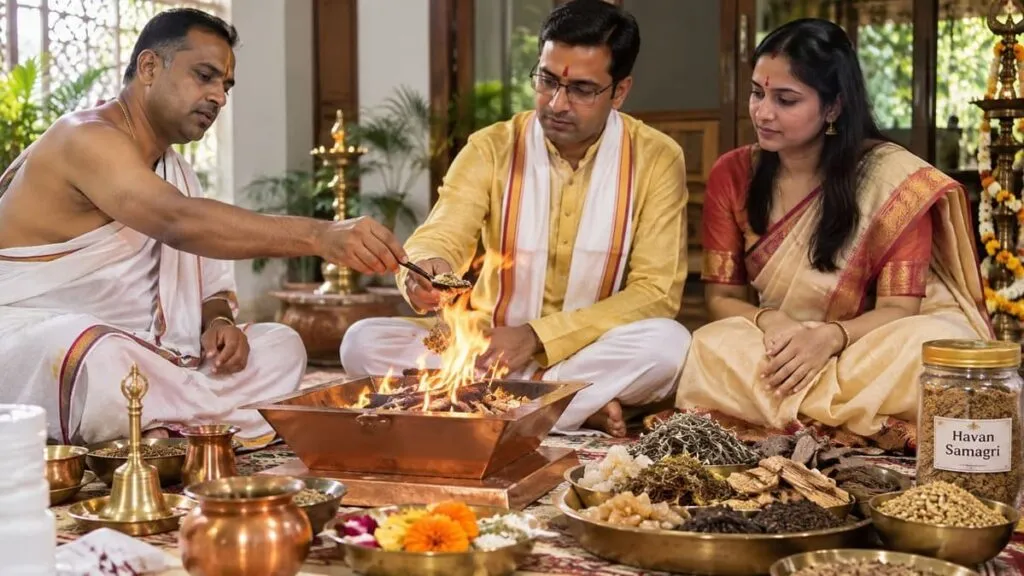
You can worship Lakshmi and Ganesh at home without Havan (हवन). During Havan, you place offerings such as ghee into a fire while saying mantras. An offering placed into the fire is called an Ahuti (आहुति).
During Aarti (आरती), you move a lit lamp in front of the Murti or photo. If Havan is part of your family Puja method, follow the steps for that Havan.
Lighting Diyas and Other Customs on Diwali Night
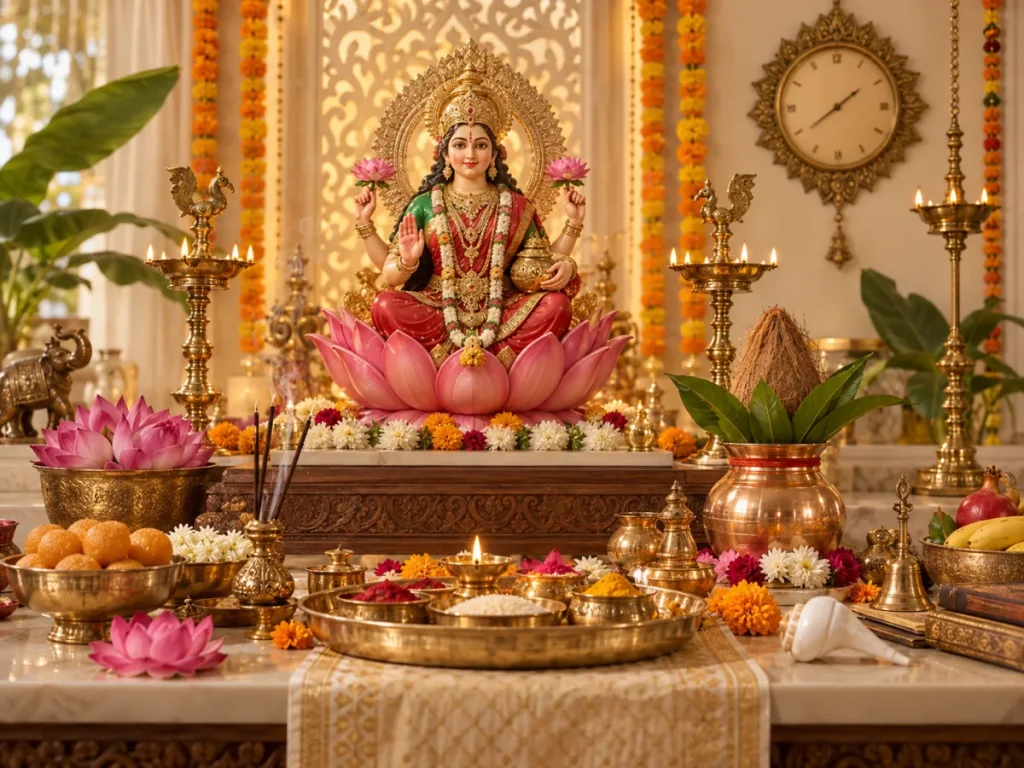
Offer a lit Diya (दीया) to Maa Lakshmi during Diwali Puja. Offering a lit lamp during worship is called Deepdan (दीपदान). Light the Diyas during Pradosh (प्रदोष), the early evening period after sunset.
You can use ghee or sesame oil (तिल का तेल) for the lamps. Place Diyas near the home Mandir and beside the entrance, away from walking areas. Draw a Rangoli (रंगोली) near the entrance using coloured powder, if this is your family custom. The design serves as a welcome for Maa Lakshmi.
You can also give another household Diyas, oil or cotton wicks (रुई की बत्ती). Helping light lamps at a temple is another way to take part in Deepdan.
Benefits of Doing Diwali Puja
You pray to Lakshmi and Ganesh for blessings (आशीर्वाद) during Diwali Puja. You ask for help at home and work, and for devotion to God.
How Satvikly Helps You Arrange Diwali Puja Samagri
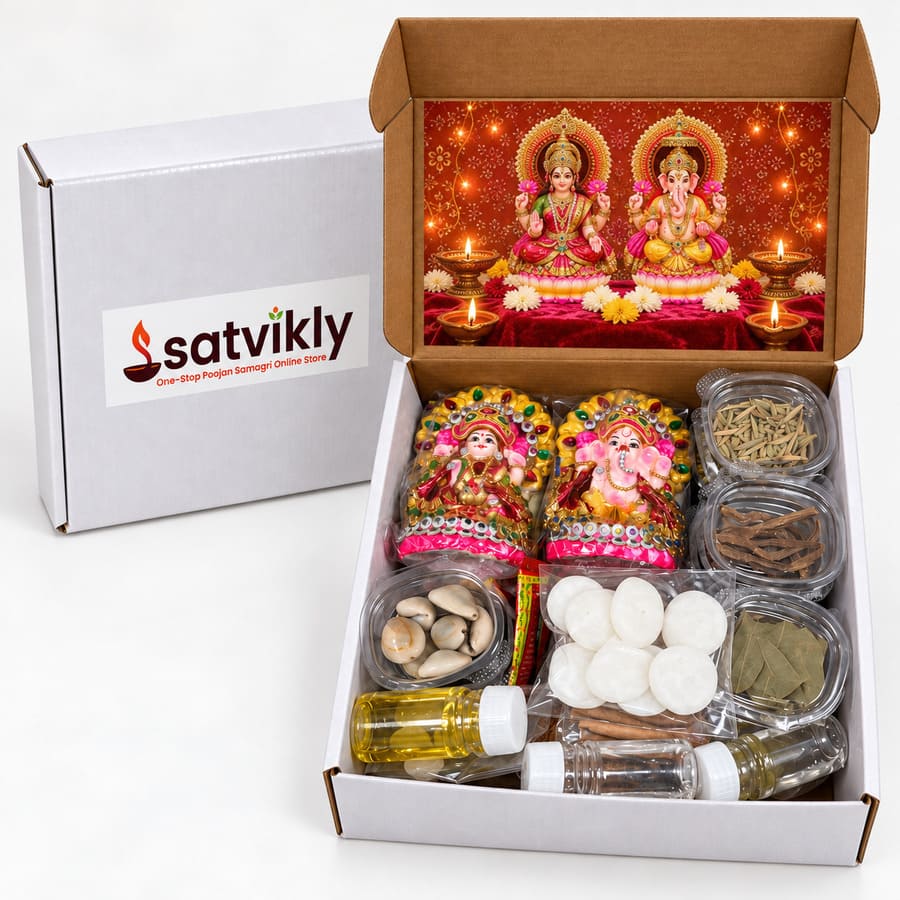
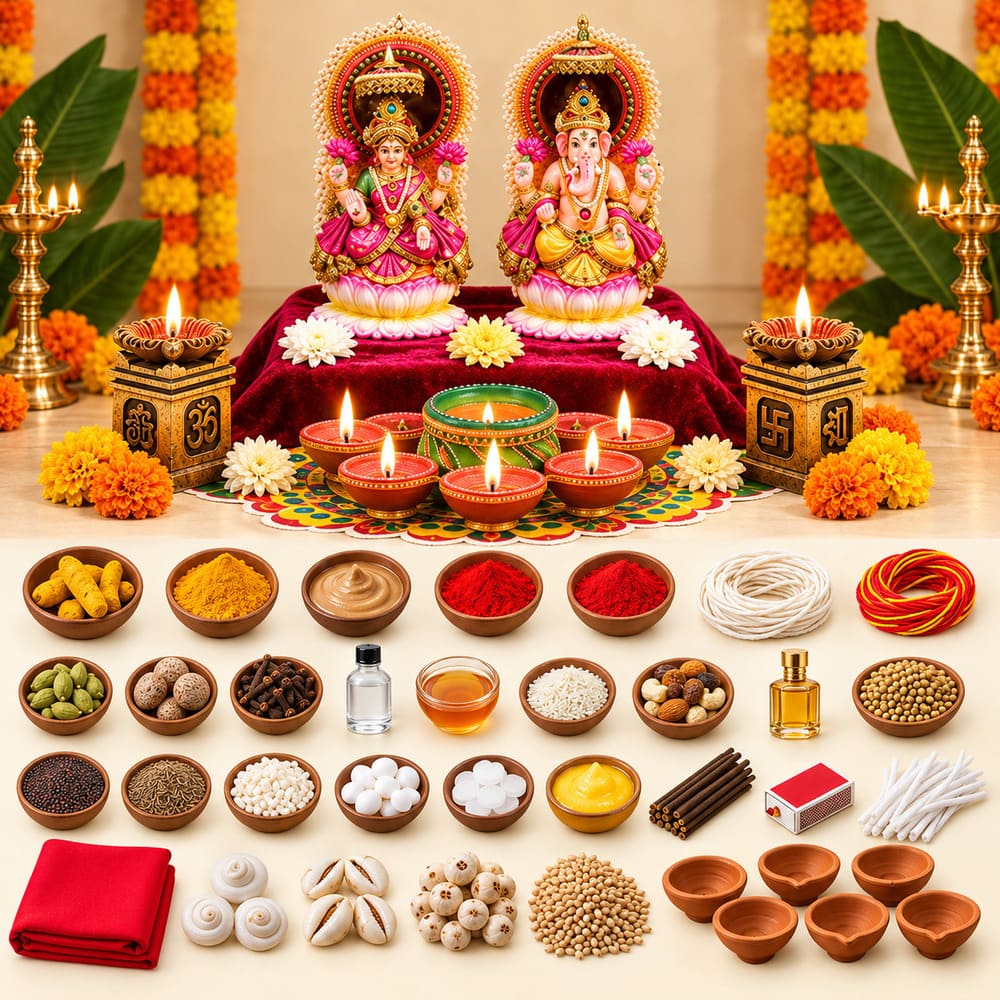
Choose a Basic or Complete Diwali Puja Kit from Satvikly. Compare the item lists and quantities to select the kit for your Lakshmi and Ganesh Puja.
Arrange fresh flowers, Durva grass (दूर्वा) and fruit separately. Prepare cooked Bhog (भोग), such as Kheer, at home. Check the delivery estimate for your address before ordering the Diwali Puja Kit. For order help, call or WhatsApp +91 931 178 0821.
Questions About Diwali Puja at Home and Office
Can I do Diwali Puja at home without a Pandit?
You can do Diwali Puja at home without a Pandit. Follow the Puja steps above, starting with Ganesh worship.
Can I do a shorter Diwali Puja if I have little time?
You can follow Panchopachar (पंचोपचार), worship with five offerings. Worship Ganesh first, then Maa Lakshmi, offering Chandan, flowers, incense, a Diya and Bhog to each. Close with Aarti. If you have taken a Vrat (व्रत), follow its required Puja steps.
Can I pray in Hindi or English if I do not know Sanskrit?
You can offer personal prayers in Hindi, English or another language you know. For Sanskrit mantras, follow the written words and listen to a recording for pronunciation.
Do I need to fast before Lakshmi Puja?
Fasting depends on the Puja method or Vrat (व्रत) you follow. Some Diwali Puja methods include a daytime fast until the evening worship.
Do I need new Lakshmi and Ganesh Murtis every Diwali?
You do not need to replace Murtis used for daily home worship every Diwali. If your family brings Murtis only for the festival, follow that custom for Visarjan (विसर्जन), or immersion in water.
Does the whole Puja need to finish within the Muhurat?
You do not need to finish every Puja step within the Lakshmi Puja Muhurat (मुहूर्त). Finish the preparations and opening prayers before the Muhurat begins. Worship Maa Lakshmi during the Muhurat and complete the closing prayers afterwards.
Can I do Diwali Puja at home and at the office on the same day?
You can worship at home and at the office on the same day. Use local Puja timings for each location and allow time to travel between them.
What should I do if I forget a mantra or miss a Puja step?
Ask Lakshmi and Ganesh to forgive any missed words or steps at the end of the Puja. This prayer is called Kshamapanam (क्षमापनम्). If you are following a Vrat, ask the person guiding it about any missed required step.
Do I need to leave a Diya burning all night?
Some Diwali Puja methods include a Diya that burns all night. If you follow this custom, an adult must watch the lamp while it burns.
What should I do with the offerings and unused Samagri after Puja?
Share edible Prasad with your family after Puja. Remove thread, foil and plastic before using flowers and leaves to make compost (खाद). Store unused dry Samagri in closed packets, separating rice and sweets from incense and Kapoor. Do not eat offerings mixed with Roli, Sindoor, Itra or lamp oil.